Browse by:
Type
Sector
Country
- Afghanistan (1)
- Albania (1)
- Antigua and Barbuda (2)
- Argentina (1)
- Australia (4)
- Austria (3)
- Bahamas (The) (3)
- Bahrain (2)
- Bangladesh (6)
- Barbados (2)
- Belgium (2)
- Belize (5)
- Benin (3)
- Bhutan (4)
- Bolivia (Plurinational State of) (3)
- Bosnia and Herzegovina (1)
- Botswana (5)
- Brazil (14)
- Brunei Darussalam (1)
- Bulgaria (1)
- Burkina Faso (1)
- Cabo Verde (2)
- Cambodia (8)
- Cameroon (4)
- Canada (24)
- Central African Republic (the) (1)
- Chad (1)
- Chile (3)
- China (28)
- Colombia (10)
- Congo (the) (2)
- Cook Islands (the) (5)
- Costa Rica (12)
- Cuba (1)
- Cyprus (1)
- Czechia (3)
- Democratic Republic of the Congo (the) (3)
- Denmark (8)
- Dominican Republic (the) (2)
- Ecuador (5)
- Egypt (3)
- El Salvador (1)
- Equatorial Guinea (1)
- Ethiopia (8)
- Federated States of Micronesia (7)
- Fiji (8)
- Finland (9)
- France (9)
- Gabon (1)
- Gambia (the) (2)
- Georgia (2)
- Germany (10)
- Ghana (10)
- Global (1)
- Greece (2)
- Grenada (2)
- Guatemala (1)
- Guyana (1)
- Haiti (3)
- Honduras (3)
- Hungary (2)
- Iceland (4)
- India (31)
- Indonesia (27)
- Iran (Islamic Republic of) (1)
- Ireland (2)
- Italy (11)
- Jamaica (3)
- Japan (11)
- Jordan (5)
- Kazakhstan (5)
- Kenya (20)
- Kiribati (5)
- Kosovo * (1)
- Kyrgyzstan (4)
- Lao (7)
- Latvia (1)
- Lebanon (2)
- Lesotho (1)
- Liberia (2)
- Madagascar (6)
- Malawi (3)
- Malaysia (7)
- Maldives (7)
- Mali (4)
- Marshall Islands (the) (6)
- Mauritania (2)
- Mauritius (3)
- Mexico (13)
- Moldova (1)
- Mongolia (7)
- Montenegro (2)
- Morocco (6)
- Mozambique (5)
- Myanmar (8)
- Namibia (4)
- Nauru (4)
- Nepal (12)
- Netherlands (Kingdom of the) (11)
- New Zealand (5)
- Niger (the) (1)
- Nigeria (3)
- Niue (6)
- North Macedonia (1)
- Norway (8)
- Pakistan (4)
- Palau (5)
- Papua New Guinea (6)
- Peru (7)
- Philippines (the) (22)
- Portugal (1)
- Qatar (1)
- Republic of Korea (14)
- Republic of Moldova (the) (1)
- Romania (2)
- Rwanda (3)
- Saint Kitts and Nevis (3)
- Saint Lucia (8)
- Saint Vincent and the Grenadines (1)
- Samoa (9)
- Saudi Arabia (1)
- Senegal (5)
- Serbia (2)
- Seychelles (1)
- Sierra Leone (3)
- Singapore (2)
- Slovakia (1)
- Slovenia (1)
- Solomon Islands (5)
- South Africa (10)
- Spain (2)
- Sri Lanka (7)
- Sudan (the) (1)
- Suriname (4)
- Sweden (9)
- Switzerland (2)
- Tajikistan (3)
- Thailand (13)
- Timor-Leste (4)
- Togo (1)
- Tonga (2)
- Trinidad and Tobago (7)
- Tunisia (4)
- Türkiye (1)
- Turkmenistan (2)
- Tuvalu (4)
- Uganda (14)
- Ukraine (4)
- United Arab Emirates (the) (1)
- United Kingdom of Great Britain and Northern Ireland (the) (15)
- United Republic of Tanzania (the) (11)
- United States of America (the) (24)
- Uruguay (1)
- Uzbekistan (7)
- Vanuatu (8)
- Viet Nam (16)
- Zambia (6)
- Zimbabwe (3)
Region
Theme
- Climate Change (251)
- Natural Capital (203)
- Development (120)
- Institutions and Governance (94)
- Indicators and Measurement (89)
- Circular Economy (76)
- Cities (73)
- Infrastructure (69)
- Risk and Resilience (53)
- Technology and Innovation (37)
- Consumption (31)
- Investment (30)
- Poverty and Equity (29)
- Standards and Regulations (28)
- Gender (26)
- Market Mechanisms (23)
- COVID-19 (20)
- Jobs (20)
- Fiscal Instruments (18)
- Trade and Supply Chains (16)
- Government Procurement (9)
- Health (9)
- Sustainable, Green, and Social Bonds (3)
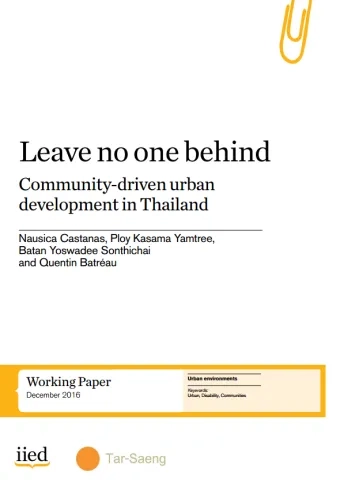
This paper examines community participation in housing projects for low-income communities in Thailand and how they have sought to ‘leave no one behind’. Baan Mankong, the government slum upgrading programme, is unique in how it has institutionalised participation. Housing projects funded by international funders, community savings or small government subsidies also use participation in their design and implementation. Simultaneously, new concepts like universal design promote an inclusive experience, taking into account the needs of all community members, irrespective of age and ability. Six case studies are presented here, focusing on central and underprivileged homes in the programme, the renovation of homes for vulnerable people, and the design of communal spaces.
Related Case Studies
The ways in which people obtain land in Uganda are changing fast. Land that used to be secured through inheritance, gifts or proof of long-term occupancy is now more commonly changing hands in the market. Those with wealth and powerful connections are frequently able to override local rules and gain...
Senegal currently has a complex and poorly regulated system of land governance, which — combined with an urbanisation trend and increasing outsider interest — is leading to land privatisation and a consequent reduction in the availability of cultivable land for small producers. Young farmers, in particular, are struggling to gain...
The Sustainable Development Goals (SDGs) set a new agenda for development, with the ambitious aim of eradicating extreme poverty within the next 15 years while also recognising environmental limits.
This new post-2015 agenda exposes the shortfalls of current approaches and demands a new approach to economic development. African countries are...