
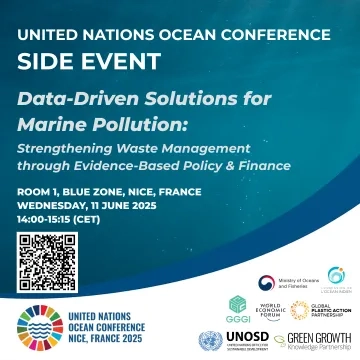
On June 11 2025 (14:00 - 15:15 CEST), the United Nations Office for Sustainable Development (UNOSD), in collaboration with the Green Growth Knowledge Partnership (GGKP), United Nations Environment Programme (UNEP), World Economic Forum, Global Plastic Action Partnership, and the Global Green Growth Institute, is hosting a side event at the UN Ocean Conference on "Data-Driven Solutions for Marine Pollution: Strengthening National Waste Management Systems through Evidence-based Policy and Finance".
Plastic pollution has emerged as one of the most pressing environmental challenges of our time, posing significant risks to ecosystems, economies, and human health. An estimated 11 million metric tons of plastic waste enter the ocean annually—a figure expected to nearly triple by 2040 if no meaningful interventions are made.
Tackling marine plastic pollution requires a systems approach that links land-based waste management with ocean health, supported by accurate data, coherent policy, and adequate financing. However, many low-income and developing countries face persistent data gaps, institutional weaknesses, and financial constraints that hinder the development and implementation of effective waste reduction strategies.
This side event focuses on innovations in data-driven policy, financing and collective action to stop pollution at source and aims to:
- Share insights on the latest data-driven approaches to understanding and addressing marine plastic pollution, with a focus on the challenges faced by developing countries with limited waste infrastructure and data-limited contexts.
- Present practical examples of integrated policy solutions and outcome based financing mechanisms being implemented to prevent plastic pollution at source.
- Discuss national experiences and collaborative models that leverage data, innovation, and capacity-building to transform waste management systems and advance circular economy practices aligned with SDGs 11, 12, and 14.
- Inspire collective action by governments, development partners, and the private sector to invest in scalable, evidence-based strategies and technologies aimed at reducing land-based sources of marine pollution.
Speakers will include ministers and cases from Member States cooperating with WEF-GPAP, GGGI and UNOSD/UNEP to implement new data collection mechanisms and innovative financing instruments for improving waste systems and reducing marine pollution in line with SDG 14.1 .
As part of its aim to strengthen UN Member States’ capacity to plan and undertake integrated sustainability transformation especially on SDGs 11,12 and 14, UNOSD will also submit a Voluntary Ocean Commitment (VOC) to support developing countries in creating data-driven policies and address capacity gaps to tackle marine pollution at source through its new Waste Management and Circular Economy Policy Support System (www.wastepolicysupport.org) developed with the UNEP and GGKP.