

In this webinar, the presenter, Ms Akshima T Ghate (Fellow, Sustainable Habitat Division, TERI), discusses the concept of green cities and the role of transport in green growth of cities in India and provides an overview of current challenges and solutions for moving transport on a green growth p
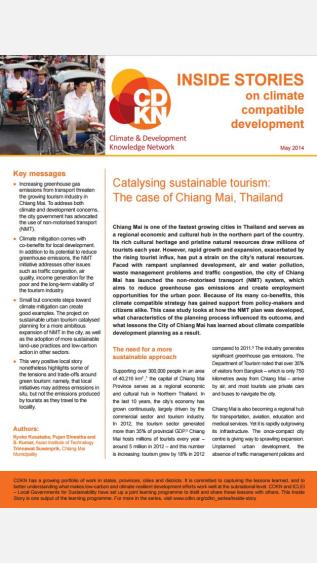
The city of Chiang Mai, Thailand has launched the non-motorised transport (NMT) system, which aims to reduce greenhouse gas emissions and create employment opportunities for people living in urban poverty.
This report was produced by the Decoupling Working Group of the International Resource Panel. It explores technological possibilities and opportunities for both developing and developed countries to accelerate decoupling and reap the environmental and economic benefits of increased resource productivity. It also examines several policy options that have proved to be successful in helping different countries to improve resource productivity in various sectors of their economy, avoiding negative impacts on the environment.
It does not seem possible for a global economy based on the current unsustainable patterns of resource use to continue into the future. The economic consequences of these patterns are already apparent in three areas: increases in resource prices, increased price volatility and disruption of environmental systems. The environment impacts of resource use are also leading to potentially irreversible changes to the world’s ecosystems, often with direct effects on people and the economy – for example through damage to health, water shortages, loss of fish stocks or increased storm damage.

This report describes efforts by the ClimateWorks Foundation and the World Bank to quantify the multiple economic, social, and environmental benefits associated with policies and projects to reduce emissions in select sectors and regions.
The report has three objectives: 1) to develop a holistic, adaptable framework to capture and measure the multiple benefits of reducing emissions of several pollutants; 2) to demonstrate how local and national policymakers, members of the international development community, and others can use this framework to design and analyze policies and projects; and 3) to contribute a compelling rationale for effectively combining climate action with sustainable development and green growth worldwide.
Kenya has one of the most dynamic economies in Africa, yet it is facing a number of pressing economic, environmental and social challenges. In recent years, Kenya has adopted several green economy-related approaches and policies, which include implementing renewable energy feed-in tariffs in 2008, embedding sustainable natural resource utilization into its 2010 Constitution and mainstreaming green economy in its Second Medium Term Plan (2013-2017).
In this context, the Ministry of Environment, Water and Natural Resources, in partnership with UNEP, commissioned a study to assess the economic benefits and challenges of investing in priority economic sectors in support of Kenya’s transition to a green economy. The study examines investments under “business-as-usual” (BAU) compared to green economy scenarios in four key sectors that are critical for the country’s green growth, namely: agriculture, energy, manufacturing and transport.
This report describes a pilot project to design an integrated framework to inform and support land use planning. It analyses interaction of social, economic and environmental factors in shaping future land use needs through a transparent system dynamics simulation model and generates projections up to 2035 to analyse the short, medium and longer-term consequences of road construction on society and land use in the DTL, along the ‘Road to Dawei’. The aim is to allow policymakers, land use planners and other interested stakeholder to test the multi-dimensional impact of green economy interventions aimed at improving sustainability in the area. Results are communicated in biophysical and economic terms, also including the valuation of natural capital (stocks, flows and ecosystem services). Though still in initial stages of development, this study has already helped understanding the key drivers of change in the area, identifying data collection needs, and defining their use to carry out a green economy analysis.