
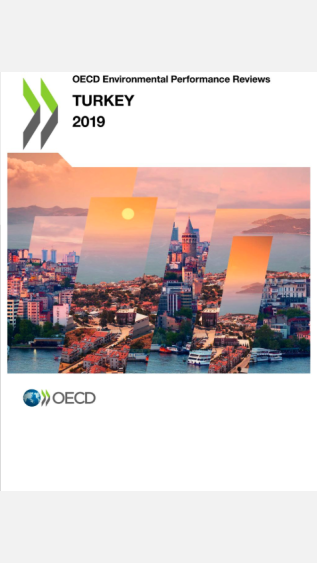
This environmental performance review shows that while Turkey's strong economic growth has been relatively decoupled from air emissions, energy use, waste generation, and water consumption, the country still faces many environmental challenges.
This publication, Beyond Fossil Fuels: Indonesia's fiscal transition, makes a first attempt at an integrated analysis of how Indonesia both taxes and subsidizes production and consumption of oil, gas, coal, and electricity (most of which is generated with coal). The paper also explores lessons learned from Indonesia’s reduction of fiscal dependence on fossil fuels.
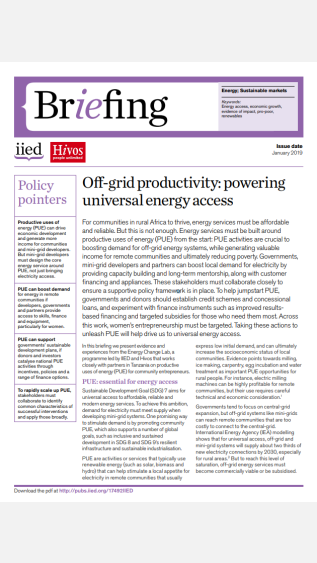
This policy brief, Off-grid productivity: powering universal energy access, outlines how mainstreaming productive uses of energy (PUE) can drive economic development, boost demand for energy, and support governments' sustainable development plans based upon evidence and experiences from the Energy Change Lab, a programme led by IIED and Hivos that works closely with partners in Tanzania on productive uses of energy (PUE) for community entrepreneurs.

Renewable energy has advanced rapidly in the Gulf Cooperation Council (GCC) countries since 2014. The project pipeline reached almost 7 gigawatts (GW) of new power generation capacity by 2018, after the United Arab Emirates (UAE) made record-breaking bids in renewable energy auctions and Saudi Arabia made solar power cost-competitive with conventional energy technologies. Abundant resources, together with strong enabling frameworks, have led to solar PV prices of below USD 0.03 per kilowatt hour and dispatchable concentrated solar power (CSP) of USD 0.07 per kilowatt hour, which is less than some utilities in the region pay for natural gas.
This report examines the question of gender equity throughout the energy sector. Building on a survey of employees, companies, and institutions, it finds that much remains to be done to boost women’s participation and allow their talents to be fully utilised.
This collection aims to provide a reference for policy makers and practitioners working to scale up bioenergy in rural areas of sub-Saharan Africa. Energy, agriculture, forestry, environment, finance and business experts all seek for solutions to provide energy and also enhance food security, social welfare and environmental sustainability.