
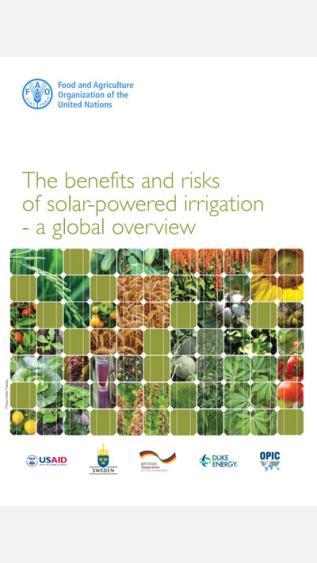
In 2015, the Food and Agriculture Organization of the United Nations (FAO) and the Deutsche Gesellschaft für Internationale Zusammenarbeit (GIZ) GmbH hosted an exploratory workshop to better understand the potential of solar-powered irrigation systems (SPIS) for developing countries.
In 2018, this report was prepared to take stock of the experiences with SPIS around the world. It includes insights on the following questions:
The Managing a Sustainable Transition to a Low-carbon Society: The socio-economic impacts of mitigation policies policy brief looks at how to identify and manage the expected and unintended socio-economic impacts of greenhouse gas (GHG) mitigation policies.
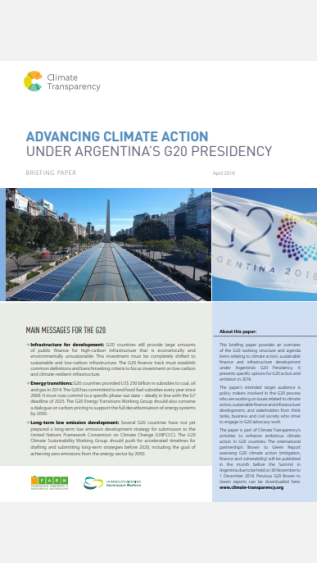
This briefing paper, Advancing Climate Action Under Argentina's G20 Presidency, provides an overview of the G20 working structure and agenda items relating to climate action, sustainable finance and infrastructure development under Argentina’s G20 Presidency. It presents specific options for G20 action and ambition in 2018.
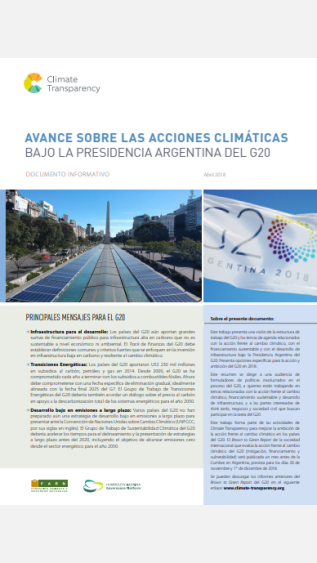
This briefing paper, Advancing Climate Action Under Argentina's G20 Presidency, provides an overview of the G20 working structure and agenda items relating to climate action, sustainable finance and infrastructure development under Argentina’s G20 Presidency. It presents specific options for G20 action and ambition in 2018.
This paper explores the role of state-owned enterprises (SOEs) in the low-carbon transition in OECD and G20 countries.
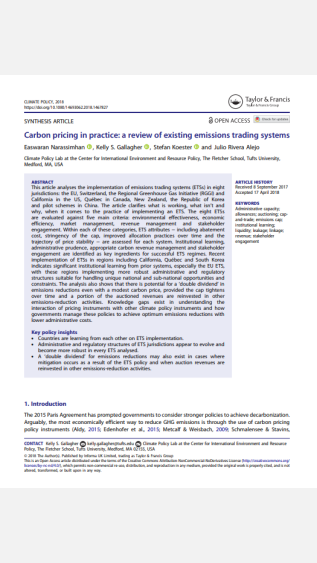
Carbon Pricing in Practice: A review of existing emissions trading systems analyses the implementation of emissions trading systems (ETSs) in eight jurisdictions: the EU, Switzerland, the Regional Greenhouse Gas Initiative (RGGI) and California in the US, Québec in Canada, New Zealand, the Republic of Korea and pilot schemes in China. The article clarifies what is working, what isn’t and why, when it comes to the practice of implementing an ETS.
The eight ETSs are evaluated against five main criteria: environmental effectiveness, economic efficiency, market management, revenue management and stakeholder engagement. Within each of these categories, ETS attributes − including abatement cost, stringency of the cap, improved allocation practices over time and the trajectory of price stability − are assessed for each system.