
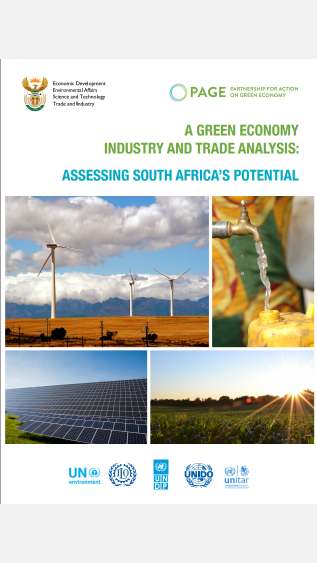
This analysis Green Economy Industry and Trade Analysis: Assessing South Africa's Potential focuses on the development of new trade opportunities for green industries in South Africa, both for import substitution and for exports.
This study Meeting Conditional Targets in Nationally Determined Contributions of Developing Countries: Renewable Energy Targets and Required Investment of GGGI Member and Partner Countries examines contributions to carbon mitigation and necessary investment for expansion of renewable energy in Global Green Growth Institute (GGGI) member countries by analyzing their NDCs and national energy plans.
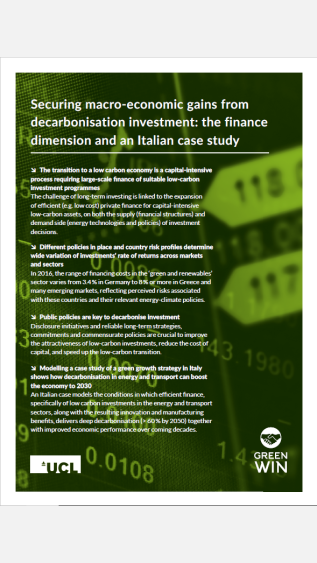
The transition to a low carbon economy is a capital-intensive process requiring large-scale finance of suitable low-carbon investment programmes. This policy brief, Securing Macro-economic Gains from Decarbonisation Investment, examines the trends driving long-term investing in low-carbon development. This challenge is linked to the expansion of efficient (e.g. low cost) private finance for capital-intensive low-carbon assets, on both the supply (financial structures) and demand side (energy technologies and policies) of investment decisions. Different policies in place and country risk profiles determine the wide variation of investments’ rate of returns across markets and sectors. In 2016, the range of financing costs in the ‘green and renewables’ sector varies from 3.4 % in Germany to 8 % or more in Greece and many emerging markets, reflecting perceived risks associated with these countries and their relevant energy-climate policies.
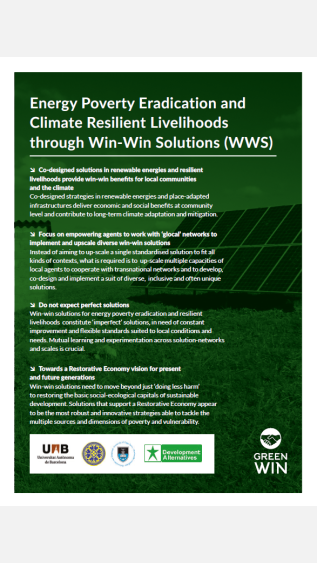
Climate change does not only pose increasing risks to local livelihoods and economies, but also provides a large array of opportunities for social innovation and international collaboration. Any attempt at limiting global warming below will require new forms of green businesses and of economic collaboration. This is especially the case in rural and poor areas of the world where there is a major potential for societal-climatic positive transformations.

The 11th International Workshop on Empirical Methods in Energy Economics will be held in Fondazione Eni Enrico Mattei (FEEM)’s premises in the Pal
The aim of the course is to develop participants’ skills in preparing proposals for low carbon climate resilient development in areas such as clean energy access, energy efficiency and adaptation to climate change so that they can mobilise climate finance, particularly from the Green Climate Fund (GCF), and catalyse the deployment of climate change solutions in developing countries.