
The latest in the World Energy Outlook report series, Energy Access Outlook 2017 expands and updates the WEO’s country-by-country data on energy access, assessing the status of over 140 countries and reviewing recent trends and policy efforts up to 2016.
The study Implementation of Nationally Determined Contributions - Indonesia Country Report analyses the country background, emissions trends, ongoing activities and barriers relating to the implementation of the Nationally Determined Contribution (NDC) of Indonesia under the UNFCCC.
The study Implementation of Nationally Determined Contributions - Viet Nam Country Report analyses the country background, emissions trends, ongoing activities and barriers relating to the implementation of the Nationally Determined Contribution (NDC) of Viet Nam under the UNFCCC
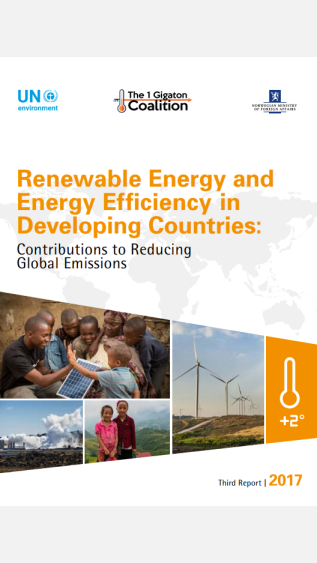
The focus of the report Renewable Energy and Energy Efficiency in Developing Countries: Contributions to Reducing Global Emissions is to evaluate the impact of renewable energy (RE) and energy efficiency (EE) projects in terms of measurable greenhouse gas emissions’ reductions. The 1 Gigaton Coaltion, Ministry of Foreign Affairs Norway
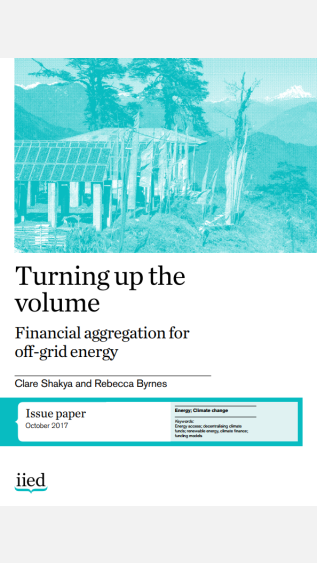
The paper Turning Up the Volume: Financial Aggregation for Off-Grid Energy seeks to give an overview of approaches to financial aggregation, highlighting how aggregation models tackle barriers to reaching scale in the decentralised small-scale renewable energy sector.
In this paper, the authors provide evidence on how the provision of social infrastructure such as reliable electricity can be leveraged to increase taxation in developing countries, particularly Sub-Saharan Africa (SSA). First, using comprehensive data from the latest round of Afrobarometer Survey the authors estimate, via the instrumental variable approach, the effect of access and reliability of electricity on tax compliance attitudes of citizens in 36 SSA countries. Evidence from the paper shows a strong positive effect of electrification on tax morales with potentially strong externalities. Also, it is found that reliability of supply is crucial in explaining the impact of electricity access on attitudes towards taxes. Second, suggestive evidence on national identity as one channel driving this impact is provided. Access to social amenities such as electricity, induces a sense of national identity among citizens, thereby incentivizing them to contribute, through taxes, towards the effective functioning of the state.