
The Tracking Clean Energy Progress 2017 (TCEP) report highlights the overall status and recent progress in developing and deploying key clean-energy technologies.
Each year, TCEP assesses the latest progress in technology and market developments, tracks overall progress, and recommends further actions. TCEP this year shows that only 3 of 26 identified clean energy technologies are on track to meet a sustainable energy transition (one more than last year). 15 technologies showed only some progress, and 8 are significantly off-track and in need of renewed action.
This working paper undertakes econometric analysis to assess the impacts of climate mitigation policies and the quality of the investment environment on investment and innovation in renewable power in OECD and G20 countries. It also assesses how countries’ investment environments interact with climate mitigation policies to influence investment and patent activity in renewable power. The paper gathered and tested data across OECD and G20 countries on more than 70 explanatory variables, which were analysed using two Poisson-family regression models: one to investigate determinants of investment flows in renewable power from 2000 until 2014; and one to investigate determinants of patent counts in renewable-power technologies from 2000 until 2012.
Results of the econometric analysis are consistent with the main hypothesis in this paper that beyond setting climate mitigation policies, policy makers need to strengthen the general investment environment and align it with climate mitigation policies in order to mobilise investment and innovation in renewable power across OECD and G20 countries.
The report is a one stop shop for learning about key developments and prospects of existing and emerging carbon initiatives. There is a continued momentum for carbon pricing. As of 2017, over 40 national and 25 subnational jurisdictions representing almost a quarter of global greenhouse gas emissions are putting a price on carbon. Over the past decade the number of jurisdictions with carbon pricing initiatives have doubled. On average, carbon pricing initiatives cover about half of the emissions in these jurisdictions, which translates to a total coverage of about 8 Gigatons of carbon dioxide or about 15% of global emissions (a fourfold increase over the past decade).
The case study Benefits of Low Emission Development Strategies: The Case of Clean Energy Policies in Bangladesh summarises the Resources to Advance LEDS Implementation (RALI) project’s modelling efforts and quantifies the potential job impacts associated with two different clean energy scenarios.
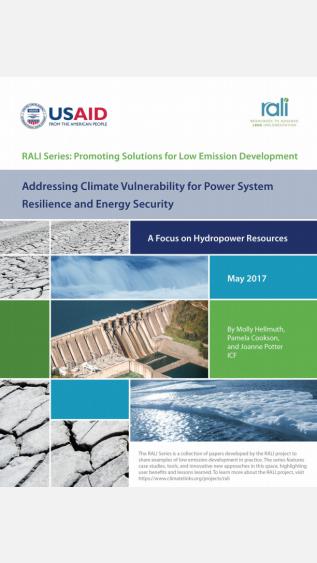
This paper aims to inform energy planners and investors about i) how climate change can affect power generation resources, particularly hydropower resources; and ii) an approach that can be taken to address climate change risks, both at the project and sector level, to improve power system resilience and enhance energy security.
In recent years the circular economy has received increasing attention worldwide due to, inter alia, the recognition that security of supply of resources and environmental sustainability are crucial for the prosperity of countries and businesses. G20 countries should consider developing frameworks that enhance the circular economy and more generally sustainable production and consumption modes. In this context, they should 1) integrate the circular economy into discussions about implementing the 2030 Agenda for Sustainable Development and the Paris Agreement, 2) work towards agreed terminologies for circular economy products and processes, 3) support demand for circular economy products and services, 4) support transparency across global supply chains, 5) facilitate financing for establishing circular supply chains and 6) proactively address the transition issues.