
The Environmental Goods Agreement (EGA), initiated in 2014, is intended to reduce tariffs on a list of goods by the signatories, after which concessions will be extended to all WTO members based on the most-favoured-nation principle. While the main objective for reducing tariffs on environmental goods in an accelerated manner is environmental concerns, including the need to address climate change, it also makes good economic sense. Among the benefits are reduced consumer prices for environmental goods. Moreover, EGA tariff elimination can spur the uptake of energy efficient goods, in turn resulting in energy savings.
This paper looks into the case of possible consumer benefits of the EGA in the United States. The authors find that total household savings from the price effect of EGA tariffs cuts overall would amount to roughly $845 million per year, disproportionally benefitting lower-income households. Moreover, the paper estimates that an increased use of energy-efficient light bulbs could save 238 million kilowatt hours, which is equivalent to 124,000 tons of coal each year, or 120% of the greenhouse gas emissions from coal in the state of Maine.

A rush of innovation in off-grid energy markets linked to falling solar prices and mobile-enabled payment schemes has led to an upsurge in clean and affordable energy access for households in poor or remote communities. But how can this growth in household energy use be matched by 'productive uses' of energy (PUE) – powering local farms and enterprises and helping to build the economy?
There has traditionally been a reluctance in the United Nations (UN) system to engage with religion. With governments that range from theocracies and nations with state religions to secular states and those that are antireligion, it is not a propitious domain for diplomacy. In addition, especially for organizations that are science-based like UN Environment, the historical antagonism of science and religion has not helped, with emotional views on both sides, and religion seen as unscientific if not dangerous.
A healthier view might acknowledge their complementarity as two knowledge systems dealing with different aspects of human experience. Faith-based organizations have long been accredited to the Department of Public Information and the Economic and Social Council, but they have simply been seen as part of the NGO Major Group, and appreciated for their usefulness in project implementation. The possibility that they might have something special to contribute to UN processes has been ignored.
Increasing agricultural productivity can have ambiguous effects on forest protection in theory: it can expand the scope of farming, which is detrimental to the forest, but it can also induce farmers to intensify their production. The authors examine these predictions using county-level data from five waves of the Brazilian Census of Agriculture. The authors identify productivity shocks using the expansion of rural electrification in Brazil during 1960-2000. The authors show that electrification increased crop productivity, and farmers subsequently both expand farming through frontier land conversion, but also shift away from land-intensive activities and into capital- and labor-intensive activities. The net effect depends on the county’s land use prior to the increase in agricultural productivity, but it reduces deforestation in the typical county in the sample.
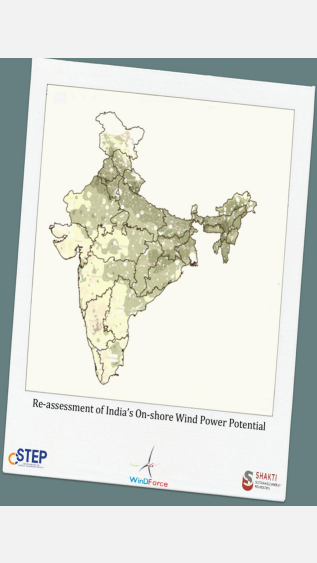
Until recently, the on-shore wind power potential in India was officially estimated to be 102 GW at a hub height of 80 m. About 26 GW of this potential has been installed in the country. However, there are multiple independent reassessment studies in the public domain that estimate the potential to be much higher. This is due to variations in assumptions and methodologies used. The main characteristic of these studies is that they take into account Land Use Land Cover (LULC) classifications and use a GIS-based methodology to estimate the wind power potential across the country. In order to achieve the national target of adding 60 GW of wind power capacity by 2022, it would be important to reassess the technical on-shore wind potential in the country and identify areas where the potential can be harnessed optimally. This would also be required to design and implement effective policies for capacity deployment. In this context, a Committee was constituted by the MNRE with an objective to reassess the technical on-shore wind potential of India for all major land types at a hub height of 100 and 120 m.

International Climate Policy (ICP) is a bi-monthly magazine published by the International Center for Climate Governance (ICCG), covering trends around international and domestic climate and energy policies, as well as carbon markets.