
China and the United States announced in December 2013 that they would undertake a reciprocal peer review of their fossil fuel subsidies under the auspices of the G20. This report, after summarising key aspects of China’s energy landscape, addresses each stage of the supply chain for fossil fuels, discussing in detail the subsidies and other measures identified in the course of the review process. It mentions that many of China’s energy policies are in a state of flux, including reforms to move toward more market-based prices and taxes that better reflect the environmental damage that economic activities can cause. Specifically, the report identifies three inefficient subsidies for upstream activities—one excise-tax refund for refined petroleum products used in oil and gas extraction and two urban land-use tax exemptions benefitting the upstream activities of state-owned CNPC and CNOOC.
This Country Planning Framework (CPF) is a high-level document guiding the Global Green Growth Institute's (GGGI) joint program with the Royal Government of Cambodia (RGC).
The study Green Economy Fiscal Policy Analysis: Mauritius identifies areas with potential for improvement through the rationalization of current fiscal measures and the mobilization of further resources for innovation and investment.
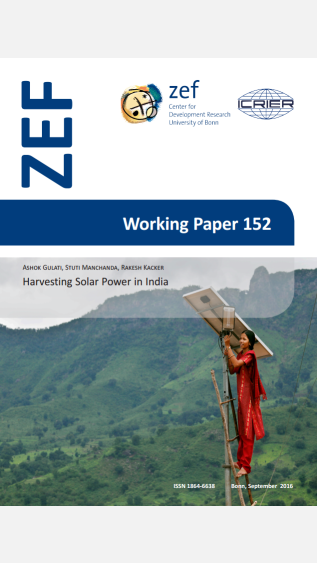
Prime Minister Narendra Modi has set an ambitious target of 100,000 MW of solar power capacity to be achieved by 2022, when India celebrates 75 years of her independence. This is a grand vision for ushering in a sort of revolution in clean energy in India in the next six years. In a country that generates more than 60 percent of its power by burning coal, and where air quality is fast worsening in several Indian cities, the need for clean energy cannot be overstated. Interestingly, Prime Minister Modi has also set another ambitious target of doubling farmers'
incomes by 2022!
The uppermost question in everyone's mind is: can these targets be achieved by 2022? This is particularly so when the current solar power capacity in the country has just touched 8000 MW by July end, 2016, and no country in the world has such an ambitious target as India has set out for 2022. On farmers' real incomes, the compound annual growth rate (CAGR) in the recent past (FY2003 to FY 2013) has been mere 3.5 percent; and doubling these incomes by 2022 would mean increasing this CAGR from 3.5 percent to more than 12 percent.
Energy issues are also a high priority in the Nordic Council. In light of this, the Nordic Council’s Environment and Natural Resources Committee and Business and Industry Committee established a working group – the Energy Group – in the spring of 2015. The group was tasked with evaluating the need for Nordic co-operation on energy policy and developing proposals for how this co-operation can be developed going forwards. The Energy Group submitted its report in the spring of 2016.
The proposals put forward by the Energy Group are concrete and provide guidance as to how future co-operation on energy could be developed.
This report assesses why and how some countries within Asia (referred to in this report as Target Countries) have achieved success in attracting renewable energy investment, what are the critical barriers to furthering renewable energy deployment, and the policy measures and practical interventions that may help to overcome these barriers. The report also highlights how lower technology costs, increased competitiveness of renewable energy, and improved energy storage solutions are making the transition to renewable energy a reality and a priority.