

The Fourth Green Growth Knowledge Platform (GGKP) Annual Conference will focus on the theme of “Transforming Development through Inclusive Green Growth” during 6-7 September 2016 at the International Convention Center on Jeju Island, R

High upfront costs and investment risks constitute critical barriers for investments in low-carbon infrastructure technologies in the Middle East and North Africa. This article uses a case study of Morocco's solar strategy for the electricity sector in order to explore how domestic versus regional/multilateral governance structures impact upon the downside risk of clean energy investments and translate into lower financing costs. The authors firstly process-trace the differential effects of governance on policy and financial de-risking, intended as risk reduction and risk transfer. Then they quantify the impact of policy and financial de-risking on the financing costs of the Ouarzazate CSP Noor 1 project.
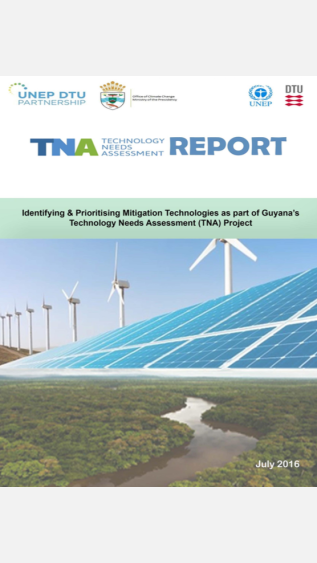
Guyana Technology Needs Assessment (TNA) project has mitigation and an adaptation component and this TNA report Technology Needs Assessment Report: Identifying and prioritizing mitigation technologies as part of Guyana's technology needs assessment (TNA) project for mitigation is one of the first main deliverables of the TNA project.

For a long time, the international community has talked about the benefits that can be created by removing wasteful fossil-fuel subsidies and freeing up expenditure for more worthwhile things—but little analysis has looked at how this works out in practice.
In large part, this is because so few countries, including among the G-20, have implemented ambitious and successful reforms. It’s also because governments don’t tend to explicitly reallocate subsidy savings. Typically, all available revenue is simply pooled together and it can be challenging to associate a decrease in one area with an increase in another.
Indonesia’s recent experiences, however, offer some rare insights into this aspect of reform. In 2015, over US$ 15 billion were saved on fuel subsidies due a combination of price increases and low world oil prices. Thanks to fortunate timing, two budgets were drawn up: one, with full-cost subsidies; and one in the light of subsidy savings.

The European Commission research programs in partnership with Udayana University and the Indonesia Climate Change Trust Fund recently conducted an international workshop in Bali to discuss a wide range of issues related to bioenergy.
The workshop on sustainability and bioenergy provided an opportunity to analyze the sustainable business and climate resilience of low-carbon transition pathways comprising bioenergy made from crop waste and residue.
The topic remains relevant with the government’s program to boost exports of its agriculture-based products from the processed food and beverage industries in Indonesia. The government plans to develop up to 400,000 hectares of new fruit plantations across the country in the next few years in an attempt to improve both the quantity and quality of local fruit production, to boost exports and survive amid competition against imported products. This plan promotes an energy-agriculture nexus particularly in bioenergy pathways in Indonesia, as fruit waste can also be used to produce biofuel.
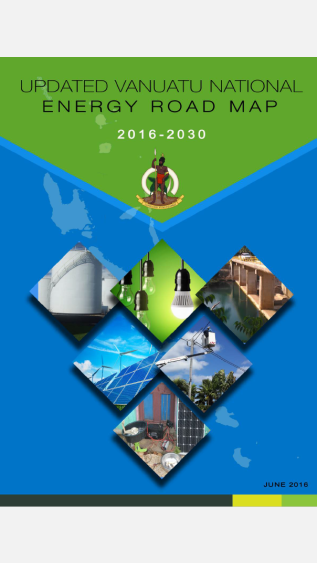
The Updated Vanuatu National Energy Road Map 2016-2030 is the key source of current information on Vanuatu’s energy sector policies, plans, and priorities in the future.