
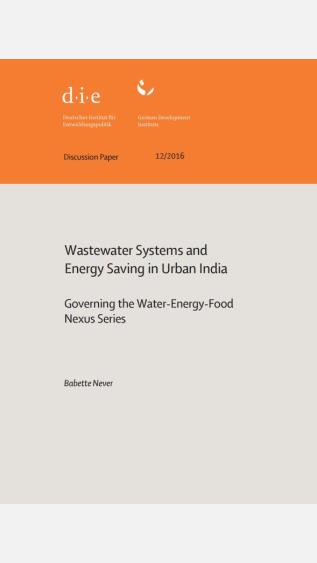
This paper analyses the interdependency of water and energy in India’s wastewater sector. Wastewater treatment plants consume a great deal of energy. Energy-efficient technologies are available, but are only spreading slowly in developing countries. In India, only 10% of all wastewater generated is treated, while energy demand is soaring. The case for investments in energy-efficient solutions thus seems clear. This case study analyses under which conditions and with which instruments integrated approaches to the water, energy and food (land) sectors (WEF-Nexus) are useful in various different wastewater systems across the country. It focuses on the identification of existing drivers of and barriers to the diffusion of energy-efficient technologies in India’s urban wastewater sector, uncovering how investments in resource- and lifecycle-oriented solutions could be enhanced.

The Green Economy (GE) paradigm aims to reconcile environmental and socio-economic objectives. Policies to deploy renewable energy (RE) are widely perceived as a way to tap the potential synergies of these objectives. It is, however, still largely unclear whether the potential of simultaneously achieving both environmental and socio-economic objectives can be fully realized, and whether and how multiple objectives influence policy design, implementation, and evaluation. We aim to contribute to this aspect of GE research by looking at selected country experiences of renewable energy deployment with respect to the socio-economic goals of job creation or energy access. Across the cases examined, we find the following implications of relevance for the GE framework: First, we confirm the important role of governmental action for GE, with the specific need to state objectives clearly and build monitoring capacity. Second, consistent with the “strong” green growth variant of GE, some of the cases suggest that while renewable deployment may indeed lead to short-term socio-economic benefits, these benefits may not last.
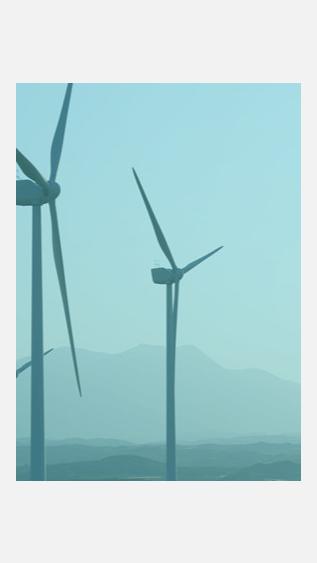
Taking into account bilateral political and economic relations, the authors analyze the role of institutional distance and host country attractiveness in location determinants of Chinese Foreign investments in EU in the renewable energy sector. Findings show that Chinese firms tend to invest in EU countries with reduced rule of law; market affluence is an attraction factor for them, but they do not seem to be human capital asset-seekers. Countries with politically stable environment are most attractive to sales/services subsidiaries; while countries with good control of corruption, low trade barriers and encouraging foreign ownership are most attractive to manufacturing subsidiaries. A large market is the most attractive factor for R&D subsidiaries, and a rich market is the most attractive factor for manufacturing subsidiaries. Manufacturing subsidiaries are more technological asset-seekers. R&D subsidiaries are the most non-human capital asset-seekers.
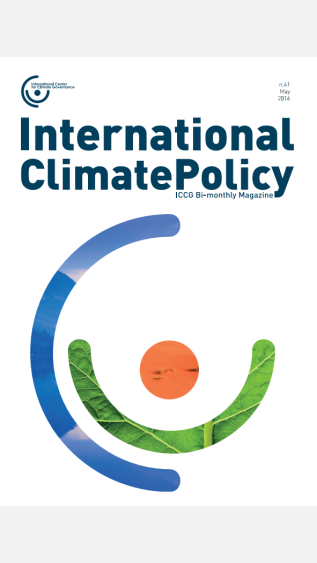
International Climate Policy (ICP) is a bi-monthly magazine published by the International Center for Climate Governance (ICCG), covering trends around international and domestic climate and energy policies, as well as carbon markets.

Are you a mid-career professional designing and overseeing low emission development strategies? Do you know of a specific team or institution that you would like to twin with to progress a specific policy or project?
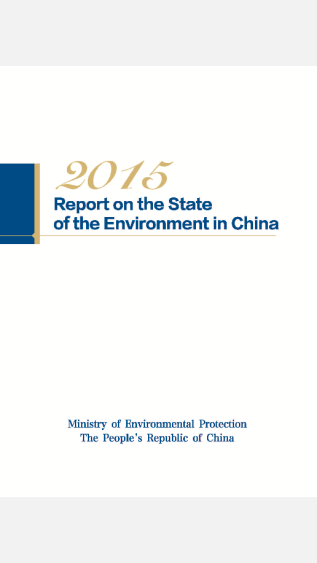
2015 Report on the State of the Environment in China gives a summary of environmental protection status in China. It provides information on atmospheric, freshwater, marine, forest, acoustic, radiation, grassland, and natural and ecological environment. The current state of the energy and transport sector is also included in this report.