
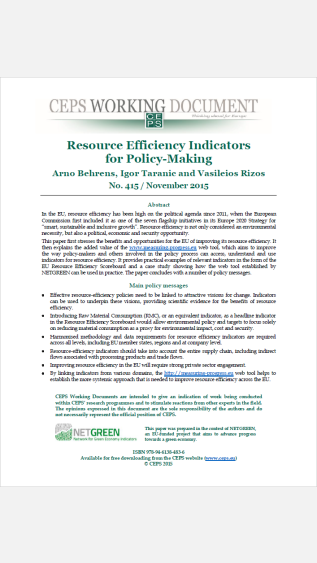
In the EU, resource efficiency has been high on the political agenda since 2011, when the European Commission first included it as one of the seven flagship initiatives in its Europe 2020 Strategy for “smart, sustainable and inclusive growth”. Resource efficiency is not only considered an environmental necessity, but also a political, economic and security opportunity.
This paper first stresses the benefits and opportunities for the EU of improving its resource efficiency. It then explains the added value of the www.measuring-progress.eu web tool, which aims to improve the way policy-makers and others involved in the policy process can access, understand and use indicators for resource efficiency. It provides practical examples of relevant indicators in the form of the EU Resource Efficiency Scoreboard and a case study showing how the web tool established by NETGREEN can be used in practice. The paper concludes with a number of policy messages.
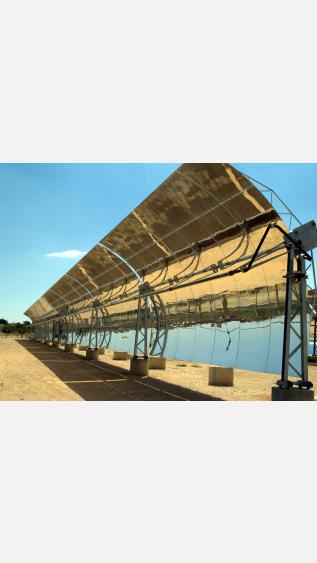
This report from ICCG provides an insight into solar systems, among other renewable sources, high potential to contribute to the MENA region’s future generation needs.
This report presents the current progress of Italy towards a green economy. It provides a clear overview of the diffusion of green businesses and practices within the manufacturing, building and trade industries, and the primary and tertiary sectors. The report highlights that about 40% of Italian firms are either:
- Core Green (i.e. firms that produce environmental goods and services, or firms whose outputs have low environmental impact); or
- Go Green (i.e. firms that are taking steps towards the greening of their supply chains and business practices).
Additionally the report offers an overview of the modern state of some themes which are strategically important for the transition to a green economy in Italy. In specific the report analyses the diffusion of renewable energy technologies, the improvements in energy efficiency, the reduced emissions of pollutant gases, circular economy, eco-innovation, land and natural resources management, ecological agriculture and sustainable transport.
Himachal Pradesh is a mountain state in India which benefits from a wealth of natural resources but is also ecologically fragile, being situated in the Himalayan region. With climate change, socio-economic and ecological vulnerability has increased and risk-based approaches have become even more relevant. Green growth and sustainable development need to take into account the impacts of climate variability to strengthen policy interventions.
This report carries out an analysis aimed to build knowledge in this area. It uses a mix of analytical tools including a climate model, soil and water assessment, and energy analysis. The report finds that the overall climatic warming projected for the state of Himachal Pradesh in the near future increase by 1.3–1.9°C for 2021–50 relative to 1971–2000. Through a state-specific energy model and onground case studies, the report identifies important issues and pressure points, relevant for the energy and environment sectors.
Punjab is a small Indian state that contributes significantly to India’s food security. While the production potential of rice and wheat crops have almost been fully exploited, there is now a stagnation in the growth process, decline in real farm incomes, and over exploitation of natural resources vis-a-vis soil health and water quality and quantity. With climate change, socio-economic and ecological vulnerability has increased and risk-based approaches have become even more relevant. Green growth and sustainable development need to take into account the impacts of climate variability to strengthen policy interventions.
In recent years, China has grown into a major provider of coal power finance in overseas markets, replacing financing by major development institutions. In September 2015, China made a surprise announcement that it would commit to “controlling public investment flowing” into high carbon overseas projects. This was followed by an announcement in November 2015 that OECD countries are committing to common standards for coal subsidies, also potentially significantly restricting international finance for coal power. However, information on overseas coal finance, particularly Chinese finance, has been lacking. CPI has been able to identify China’s role in international coal power generation deployment to provide the most complete estimate of Chinese finance for overseas coal projects to date as well as estimates of the potential impact of China’s recent announcement.