
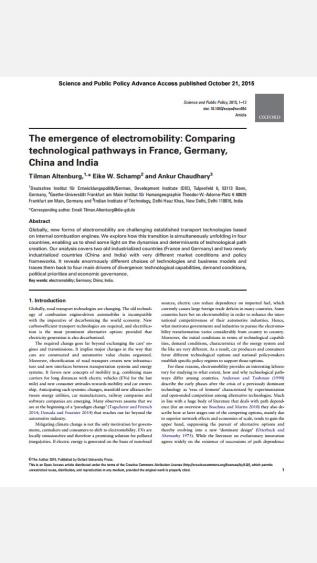
Globally, new forms of electromobility are challenging established transport technologies based on internal combustion engines. The authors explore how this transition is simultaneously unfolding in four countries, enabling them to shed some light on the dynamics and determinants of technological path creation. The paper's analysis covers two old industrialized countries (France and Germany) and two newly industrialized countries (China and India) with very different market conditions and policy frameworks. It reveals enormously different choices of technologies and business models and traces them back to four main drivers of divergence: technological capabilities, demand conditions, political priorities and economic governance.

Big cities drive economic growth, 60% of global GDP is generated in only 600 urban centers. At the same time, urban areas consume more than two-thirds of the world’s primary energy and produce nearly four-fifths of all global greenhouse gas emissions (GHG emissions). In this context, mayors have to make strong arguments on economic as well as environmental aspects of green projects to foster viable greening of their cities.
This report is an attempt to provide a bridge between the published estimates of economic benefits and estimates obtained directly from cities, and the use of such estimates by decision-makers in specific settings. The report aims to provide best practice insights into the economic co-benefits of green city initiatives, how they are measured and the data and methodologies used.
Information has been gathered from selected cities and five key sectors where data is available, namely the buildings sector, public and private transportation, energy efficiency and community scale development.
This report presents a model that analyses fossil fuel subsidy reform across 20 countries showing an average reduction in national GHG emissions of 11% by 2020, and average annual government savings of USD 93 per tonne of CO2 abated. With a modest recycling of resources to renewables and energy efficiency, emissions reductions can be improved to an average of 18%. Some countries have included reforms in Intended Nationally Determined Contributions, toward a climate agreement. The report presents case studies from Morocco, Philippines and Jordan and was authored by the Global Subsidies Initiative of IISD, as part of the Nordic Prime Ministers’ green growth initiative.
Environment at a Glance 2015 updates key environmental indicators and relevant socio-economic and sectoral indicators to track OECD country progress on major environmental issues and inform policy development and evaluation. This year's edition includes increased coverage of environmentally related taxation, ODA and R&D expenditure.
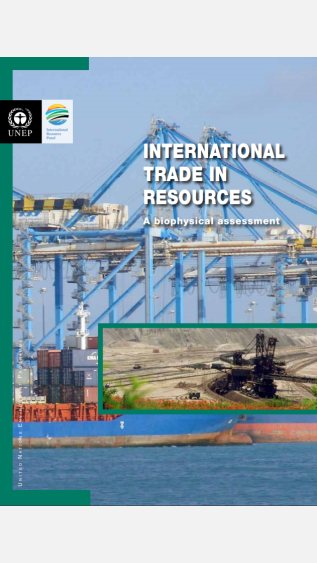
This report is an exploration of the role of international trade in increasing resource efficiency, reducing environmental impact and promoting equitable and inclusive growth. The value of international trade has increased over six-fold and its volume more than doubled between 1980 and 2010. This report examines upstream resource requirements - the materials, energy, land and water used in the country of origin for producing traded goods, but left behind as wastes and emissions. It focuses more on environmental efficiency than on economic efficiency, and explains how trade could be resource efficient by allowing commodities to be obtained from countries/locations where their production requires fewer resources and generates fewer environmental impacts than in others. However, as the publication underlines, higher trade levels, declining ore grades and decreasing energy returns upon energy investment, higher food demand and diminishing land productivity further increase the upstream resource requirements of trade, which could negate the benefits of a potentially more resource efficient allocation of extraction and production activities via world trade.
This report reviews trends and progress on climate change mitigation policies in 34 OECD countries and 10 partner economies (Brazil, China, Colombia, Costa Rica, Indonesia, India, Latvia, Lithuania, the Russian Federation and South Africa), as well as in the European Union. Together, these countries account for over 80% of global GHG emissions. It covers three areas: 1) mitigation targets and goals, 2) carbon pricing instruments (such as energy and carbon taxation, emissions trading systems, as well as support for fossil fuels) and 3) key domestic policy settings in the energy and other sectors (including renewable energy, power generation and transport, innovation and R&D, and mitigation policies in agriculture, forestry, industry and waste sectors). The report is accompanied by an online country profiles tool containing more detailed information.