
This 2018 edition of the Joint Report on Multilateral Development Banks Climate Finance was prepared by the European Bank for Reconstruction and Development, together with partners the African Development Bank, the Asian Development Bank, the European Investment Bank, the Inter-American Development Bank Group, the Islamic Development Bank and the World Bank Group.
From 29 April –21 June 2019, UNITAR and UN Environment are offering the e-course, Introduction to Sustainable Consumption and Production in Africa. The course is designed to assist policymakers in Africa in developing, implementing, monitoring and evaluating policies supporting a transition towards Sustainable Consumption and Production (SCP).
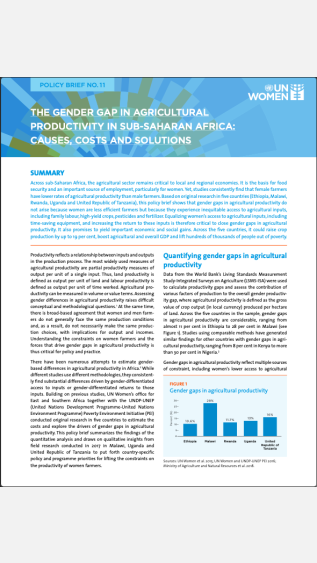
This policy brief shows that gender gaps in agricultural productivity do not arise because women are less efficient farmers but because they experience inequitable access to agricultural inputs, including family labour, high-yield crops, pesticides and fertilizer. Equalizing women’s access to agricultural inputs, including time-saving equipment, and increasing the return to these inputs is therefore critical to close gender gaps in agricultural productivity.
This report explores how a number of African countries are designing systems to simultaneously achieve their climate targets and the Sustainable Development Goals (SDGs). Building on a study of Asian Nationally Determined Contributions (NDCs), the report takes an in-depth look at NDCs of seven African countries: Burkina Faso, the Central African Republic (CAR), Ghana, Malawi, Niger, Swaziland, and Zambia, and analyzes NDCs of several other African countries.
Launched in November 2017, the International Energy Agency's (IEA) Clean Energy Transitions Programme (CETP) aims to accelerate global clean energy transitions. This report outlines CETP efforts during the first year (2018), including summaries of accomplishments from the six priority countries as well as how activities were tailored for each country.
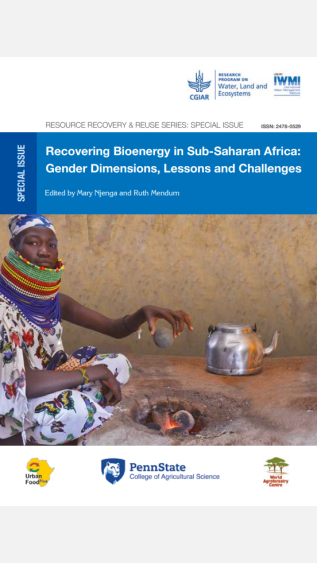
This publication focuses on the management of the nexus of energy, food and natural resources in sub-Saharan Africa, with a clear focus on gender roles and implications. It presents case studies that showcase a range of options available to improve biomass use, especially in locations and among populations who currently depend on conventional fuels like firewood or charcoal. Although many of these options are context specific, the provided examples demonstrate that generalizable options exist to improve energy access, reduce waste, protect our soils and empower women.