

Improving energy-efficiency is essential to any strategy to reduce global emissions of greenhouse gases (GHGs). New generations of household appliances are becoming ever more energy-efficient due to continuing technological advances, often spurred by government policies. These products are manufactured, sold and used on a global scale not imagined a decade ago. Yet achieving the full market potential of these best-available technologies has proven elusive, due to a variety of factors, some of which are trade-related. This paper considers these factors and looks at ways of addressing them. It examines four products in the residential sector that have considerable potential for significantly reducing GHG emissions: refrigerators, televisions, lighting, and air conditioners. These technologies are also widely traded globally. To develop a better understanding of how improvements in energy efficiency could affect CO2 emission reductions, the paper draws on work undertaken by Japan’s Research Institute of Innovative Technology for the Earth (RITE), using their DNE21+ model.
This paper fills a gap in the macroeconomic literature on renewable sources of energy. It offers a definition of green investment and analyzes the trends and determinants of this investment over the last decade for 35 advanced and emerging countries. We use a new multi-country historical dataset and find that green investment has become a key driver of the energy sector and that its rapid growth is now mostly driven by China. Our econometric results suggest that green investment is boosted by economic growth, a sound financial system conducive to low interest rates, and high fuel prices. We also find that some policy interventions, such as the introduction of carbon pricing schemes, or “feed-in-tariffs,” which require use of “green”energy, have a positive and significant impact on green investment. Other interventions, such as biofuel support, do not appear to be associated with higher green investment.
This report is concerned with challenges and opportunities to grow local economic activity, employment and skills in response to climate change.
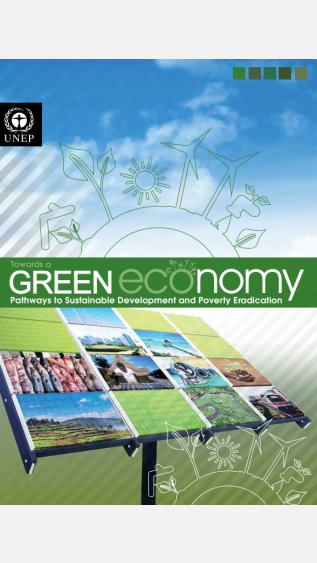
The Green Economy Report is compiled by UNEP’s Green Economy Initiative in collaboration with economists and experts worldwide. It demonstrates that the greening of economies is not generally a drag on growth but rather a new engine of growth; that it is a net generator of decent jobs, and that it is also a vital strategy for the elimination of persistent poverty. The report also seeks to motivate policy makers to create the enabling conditions for increased investments in a transition to a green economy.
The report includes chapters on the following areas:
- Agriculture
- Fisheries
- Water
- Forests
- Renewable Energy
- Manufacturing
- Waste
- Buildings
- Transport
- Tourism
- Cities
- Modelling
- Finance
A fundamental transformation is required in the way we produce, deliver and consume energy. The current energy system is highly dependent on fossil fuels, whose combustion accounted for 84 per cent of global greenhouse gas emissions in 2009. Global demand for energy is rapidly increasing, because of population and economic growth, especially in large emerging market economies, which will account for 90 per cent of energy demand growth to 2035. At the same time, 1.3 billion people worldwide still lack access to electricity.
The OECD and IEA have released the joint report Green Growth Studies: Energy, which highlights the challenges facing energy producers and users, and how they can be addressed using green growth policies.
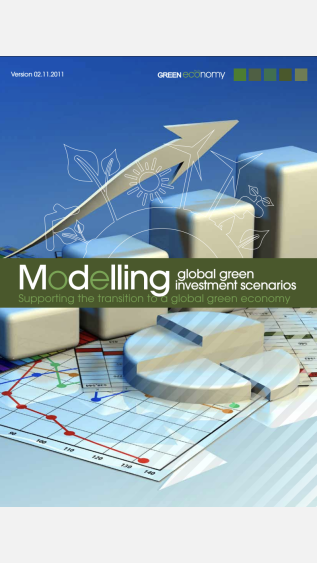
This report examines the economic and environmental benefits of transitioning to a green economy compared with a business-as-usual (BAU) development path.