

Quoting a joint analysis undertaken by the OECD and the IEA, G-20 leaders committed in September 2009 to "rationalize and phase out over the medium term inefficient fossil-fuel subsidies that encourage wasteful consumption." This report draws on previous OECD work to assess the impact on international trade of phasing out fossil-fuel consumption subsidies provided mainly by developing and emerging economies. The analysis employed the OECD’s ENV-Linkages General-Equilibrium model and used the IEA’s estimates of consumer subsidies, which measure the gap existing between the domestic prices of fossil fuels and an international reference benchmark. It shows that a co-ordinated multilateral removal of fossil-fuel consumption subsidies over the 2013-2020 period would increase global trade volumes by a very small amount (0.1%) by 2020. While seemingly negligible, this increase hides the large disparities that are observed across countries (or regions) and products. Under the central scenario, which assumes a multilateral subsidy removal over the 2013-2020 period, trade in natural gas would be most affected, with a 6% decrease by 2020.
A rather young but rapidly accelerating biofuel industry has recently emerged in China. However, there is no legislation or policy specifically regulating biofuels or bioenergy. In addition, most of the regulatory functions are undertaken by policy initiatives rather than by law. As a result, the regulation and, in a broader context, governance of biofuels still face several major obstacles, including unclear development directions, ignored impact of biofuels development on society, environment and economy, and limited public participation. This paper argues that legislation on biofuels in the form of joint departmental rule is a departure for a comprehensive regulatory framework to overcome the current obstacles and to realize the sustainable development of the biofuels industry in China.
This article appears in the Special Issue: Green Economy and Sustainable Development.
Korea’s greenhouse gas emissions almost doubled between 1990 and 2005, the highest growth rate in the OECD area. Korea recently set a target of reducing emissions by 30% by 2020 relative to a “business as usual” baseline, implying a 4% cut from the 2005 level. Achieving this objective in a cost-effective manner requires moving from a strategy based on voluntary commitments by firms to market-based instruments. The priority is to establish a comprehensive cap-and-trade scheme, supplemented, if necessary, by carbon taxes in areas not covered by trading. Achieving a significant cut in emissions requires a shift from energy-intensive industries to low-carbon ones. Korea is strongly committed to promoting green growth through its Five-Year Plan, which envisages spending 2% of GDP per year through 2013. One challenge is to ensure that these expenditures are efficiently targeted so as to develop green technologies, while avoiding the risks inherent in industrial policy.
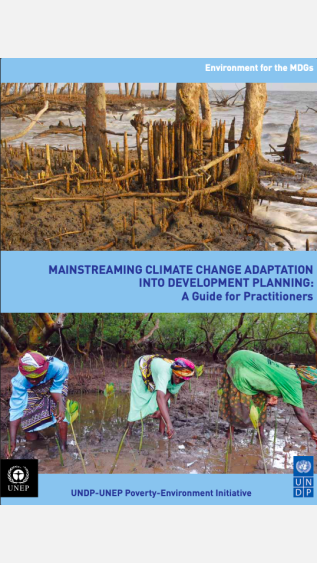
This guide addresses the need for integrating climate change adaptation considerations into the work of the Poverty-Environment Initiative (PEI). In addition, by building on PEI lessons in the field of poverty-environment mainstreaming in general, the guide can provide useful insights to adaptation specialists interested in mainstreaming their efforts.
The document provides guidance principles for Life Cycle Assessment (LCA) databases; this includes how to collect raw data, how to develop datasets and how to manage databases. The publication also addresses questions concerning data documentation and review, coordination among databases, capacity building and future scenarios. LCA databases provide fundamental energy, materials, land, water consumption data and emissions data into water, air and soil for a wide range of processes, products and materials. In this way, the publication provides the bridge between the data users and the data providers, making basic information easily accessible for computing the environmental footprints of materials and products that are key to make and judge green claims and to allow institutional and individual consumers to make informed consumption choices.
The document is the output of the UNEP/SETAC "Global Guidance for LCA Databases" workshop, (30 January - 4 February 2011, Shonan, Japan), also known as the ‘Shonan Guidance Principles’ workshop.
Sustainable energy is central to a green economy. This policy brief provides the framework for the discussion on energy for sustainable development. This document describes how access to modern energy services is described as a pre-requisite for economic and social development; explains how the reduction of global energy intensity and the expanded use of renewable energy are ways to the meet the growing energy demand, while mitigating carbon emissions and limiting the damage to the environment; and finally, argues the need for a renewed global effort to make energy a pillar of a Green Economy.