

This report provides an overview of PFMs that mobilise and leverage commercial financing, build commercially sustainable markets, and increase capacity to deliver clean energy and other climate-mitigation technologies, projects and businesses. These mechanisms can play a prominent role in the implementation of an international mitigation strategy.
The report is based on a substantial body of experience in a wide variety of developed and developing countries. It suggests ways in which PFMs could be used at the national and international scale, offers scale up and replication strategies, and identifies how they might fit into a new financial framework under the UNFCCC.
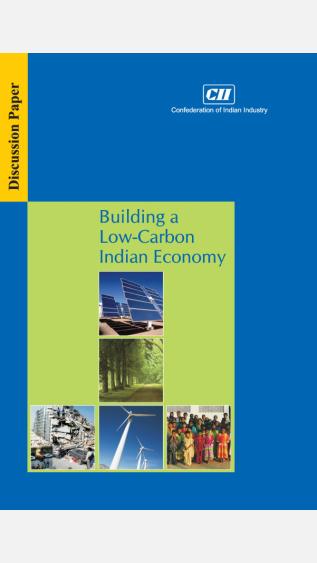
The ‘Building a Low‐Carbon Indian Economy’ report, by the Confederation of Indian Industry, recognises that although India is undergoing a phase of rapid industrial development there are clear signs that ‘industry in India has adopted an approach that can help India leapfrog to a low‐carbon economy’. The report asserts that this can be done by adopting suitable policies to promote non‐carbon intensive fuels, renewables and state‐of‐the‐art technologies to promote energy efficiency.
The strategy identifies 12 priority areas with the potential to mitigate India’s carbon emissions and put the country on the path to a low‐carbon economy. These are: Renewable Energy, Energy Efficiency, Cleaner Conventional Energy Technologies, Hydrogen Fuel Cells, Free and Open Markets, Green Buildings, The Aviation Sector, Water Efficiency, Agriculture, Afforestation, Research & Development and Financing.
The document concludes by providing specific actions to be undertaken by government, industry and civil society independently, that will put India on a path to a low‐carbon economy.
Guided by the Scientific Outlook on Development, the Chinese government is accelerating its development of a modern energy industry, taking resource conservation and environmental protection as two basic state policies, giving prominence to building a resource-conserving and environment-friendly
The Energy Conservation Law of the People's Republic of China is formulated for the purpose of promoting energy conservation in the whole society, improving energy utilization efficiency, protecting and ameliorating the environment, and striving for all round, balanced and sustainable development of the economy and the society.
Financial constraints are among the most important barriers to proper municipal solid waste (MSW) management in the developing countries of Asia and the Pacific. The reform of fiscal measures and the adoption of economic instruments could help local governments by increasing revenue, causing MSW management authorities in the region to attempt to recover costs by levying fees for their services. However, the polluter pays principle is not easy to enforce in countries where the population has never paid the actual cost of public services aimed at mitigating environmental damage. Since it directly affects their available income, local people often do not understand why they should pay for these services while at the same time, rising public awareness of environmental issues is making it more difficult to implement low-cost solutions, such as the creation of new disposal sites. The fermentation of waste in open dumps and landfills generates landfill gas (LFG), a major component of which is methane, a powerful greenhouse gas (GHG). Proper management of MSW which includes utilizing this LFG, can thus contribute to climate change mitigation.
China's National Climate Change Programme outlines the objectives, basic principles, key areas of actions as well as policies and measures to address climate change for the period up to 2010.