
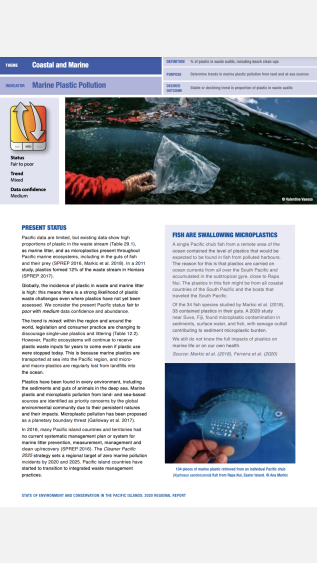
This document recommends ways Pacific island countries can transition to integrated waste management practices, particularly when it comes to plastics in the marine environment.
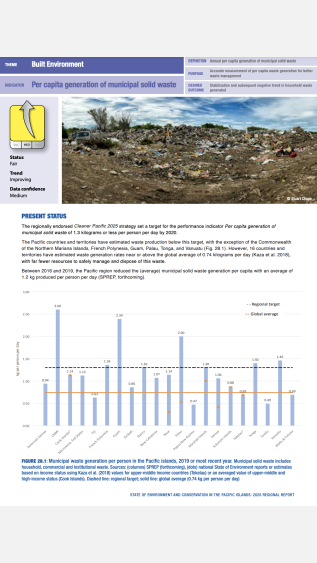
This brief show that reducing per capita waste generation provides financial benefits and greater safety for people and ecosystems.
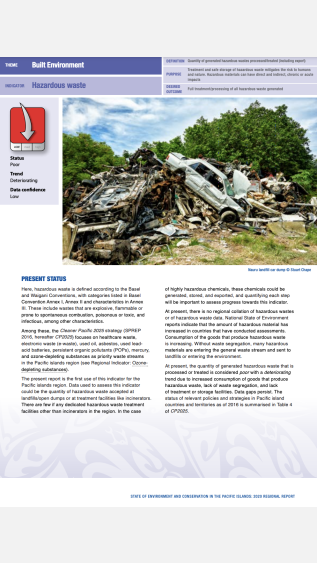
Here, hazardous waste is defined according to the Basel and Waigani Conventions, with categories listed in Basel Convention Annex I, Annex II and characteristics in Annex III. These include wastes that are explosive, flammable or prone to spontaneous combustion, poisonous or toxic, and infectious, among other characteristics.
This report presents impactful urban policy options and case studies that can help cities accelerate their green agendas.
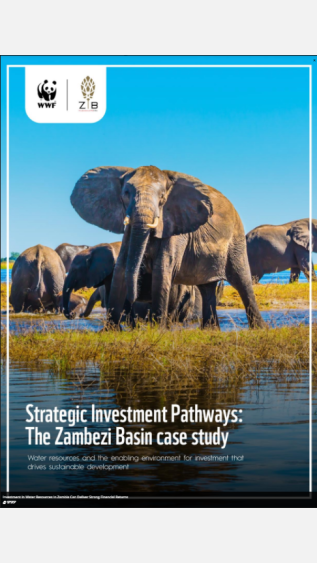
Zambia is one of the fastest growing economies in Sub-Saharan Africa. The country is endowed with rich natural resources: minerals, forests, agricultural land and water resources. Sustaining long-term economic development requires the use of existing natural resources in an effective and efficient way that delivers benefits to communities, economies and the environment.
This policy brief summarizes the use of the innovative integrated economic and environmental model (IEEM) coupled with land use land cover (LULC), and ecosystem service models (IEEM+ESM) to understand how various policy interventions can affect economic, poverty amelioration, and environmental outcomes in Rwanda.