
This study calls for a holistic approach that combines green finance and financial inclusion policies in an integrated inclusive green finance (IGF) approach. It provides a conceptual framework of how financial inclusion can enable and support climate change adaptation and mitigation in principle. It also approaches inclusive green finance from a policymaker's perspective.
This report introduces a new concept — Whole-System Zero-Emissions Demonstration (WS-ZED). The WS-ZED concept goes one step further than net-zero carbon and proposes a broader concept to reveal the added value of synergy among net-zero carbon, net-zero waste, and net-zero pollution. This new concept aims to resolve these growth challenges by adopting a holistic approach to put in place urban management policies to combat both climate change and environmental degradation.
The Global Bioenergy Statistics report focusses on the global development of biomass to energy – supply, production and consumption. The data is presented on different geographical levels – global, continental and regional levels covering all sectors of bioenergy, including liquid biofuels, biogas, pellets, forestry, agriculture, and waste.
This policy brief discusses COVID-19's impact on Asian and Pacific economies, their responses to and financing allocated for COVID-19 and climate change, and specific actions being taken related to energy, transport, tourism, land use, water, waste, and disaster risk management.
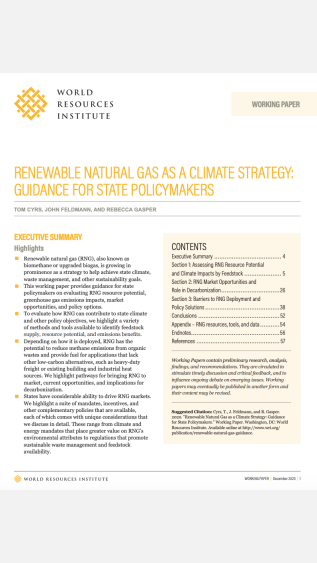
This paper provides comprehensive guidance for policymakers on evaluating renewable natural gas (RNG) resource potential, greenhouse gas emissions impacts, and deployment and policy options at the state level.
The 2020 NDC Update report discusses countries’ preparedness to ratchet up ambition in the first NDC update cycle amidst a global health crisis. It discusses the progress of NDC implementation since 2015, expectations for the NDC update cycle, progress on the development of LTSs, and the potential impact of COVID-19 on climate planning.