
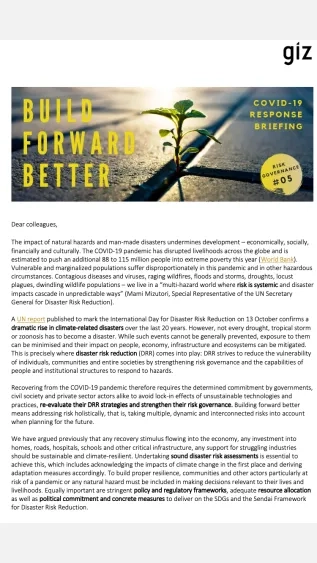
This brief focuses on COVID-19 responses targeted at strengthening risk governance – although comprehensive risk management is (or should be) the very foundation of any “green” stimulus measure and proposition by governments, multilateral organisations, academia, civil society, and other actors at the national and international level in order to achieve a sustainable, inclusive, and resilient recovery from the pandemic. The compilation shows that, to date, it is mainly international and civil society organisations pointing out the link to DRR, but some governments are highlighting the necessity to strengthen their risk governance to build forward better and prepare themselves for future shocks.
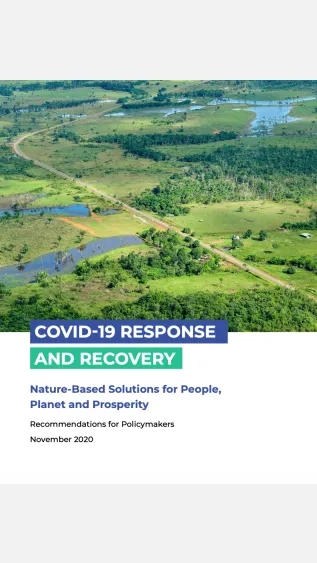
This report offers recommendations to policymakers to meet the challenge of achieving an equitable carbon-neutral, nature-positive economic recovery and a sustainable future.
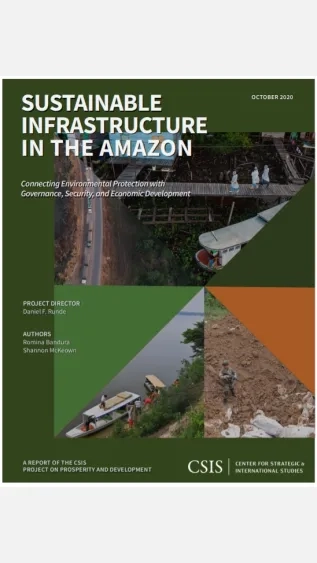
This report analyzes how deforestation in the Amazon Basin is linked with weak governance, insecurity and conflict, and inadequate infrastructure planning in the region
This policy brief focuses on practical ways in which countries can use green budgeting and tax policy tools to implement stimulus packages that support a green recovery, and the inter-linked role of both tax and spend measures in aligning stimulus programmes with decarbonisation objectives.

This research explores the experiences of three cities – Mexico City, Beijing, and Delhi – which offers lessons on how countries can tackle the growing challenge of air pollution.
This paper sets out a new framing of the challenges and opportunities for scaling up financing and investment for a sustainable ocean economy.