
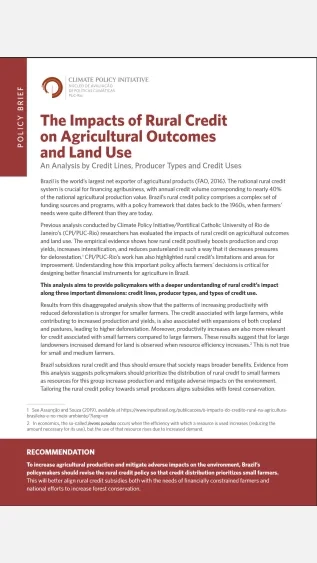
In The Impacts of Rural Credit on Agricultural Outcomes and Land Use, Climate Policy Initiative provides a detailed impact analysis of the Brazilian Rural Credit policy on agricultural production, land use and deforestation. The impact estimation is done separately for credit lines, producer types, and types of credit use.
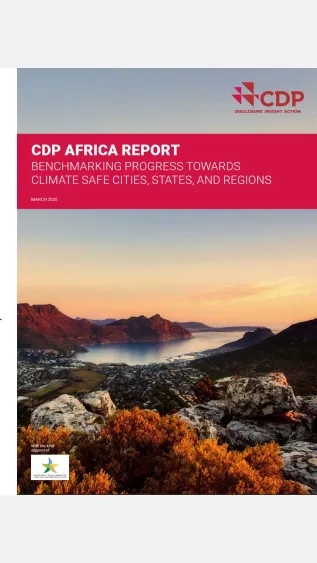
The CDP Africa Report - Benchmarking progress towards climate safe cities, states, and regions provides a snapshot of carbon disclosures and associated standards in Africa.
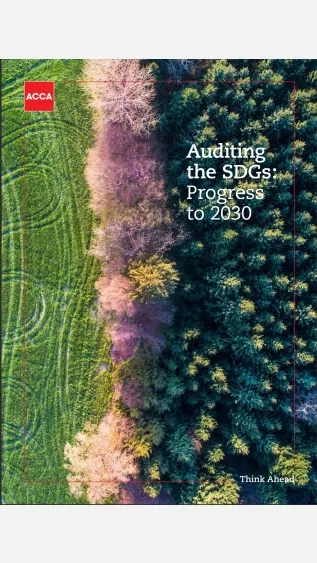
The Auditing the SDGs: Progress to 2030 report explores how Supreme Audit Institutions (SAIs) examine the challenges presented by the SDGs in government decision-making and why their ability to hold governments to account on this ambitious agenda matters.

The organizations Environmental Finance, Finance for Tomorrow, Global Landscapes Forum, Mirova and IDH – The Sustainable Trade Initiative organized three events in November 2019 dedicated to exploring ways of investing in natural capital. These events aimed to create common ground and understanding about natural capital investments, help build a track record for investors, and foster partnerships among stakeholders. This Outlook 2020 builds on that experience, in order to share recommendations for actions to enable systemic change in a joint outcome.
These guidelines are primarily written for government agencies who wish to take a common stepwise approach to measure Sustainable Public Procurement (SPP) actions and policies in their country. They are designed both for beginning countries, as well as for those who already have an SPP plan in operation and who would like to improve and report on it in the context of the SDG 12.
Tackling biodiversity loss is a growing priority for human survival. Introducing incentives for positive actions could play a key role in helping to reverse this loss. This paper explores the potential of using a novel approach to promote biodiversity conservation. It explains the concept of biodiversity credits or ‘biocredits’, describing them as coherent units of measurement that track conservation actions and outcomes and can help improve tracking and transparency.