
This report investigates clean energy policy strategies in France, Germany, Spain, Italy, Switzerland, and the European Union (EU) as a whole and finds that none of these pathways would lead to decarbonisation to the extent required to fulfil the European (Union and national) commitments under the Paris Agreement. The report points to a greater need for power system flexibility in order to expand intermittent renewables.
This report identifies the main ‘data barriers’ to effective natural capital assessment and decision making in the private sector and outlines potential response options for each of these barriers. The report was produced in the context of the ‘Data Information Flow’ project, led by the Natural Capital Coalition / UN Environment World Conservation Monitoring Centre (UNEP-WCMC).
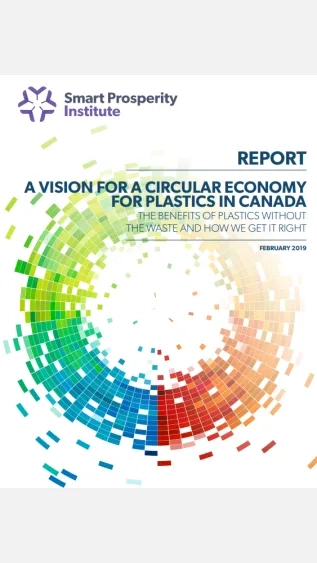
A plastics circular economy in Canada would recirculate materials in an environmentally- and financially-sustainable closed loop. It reduces waste and emissions while capturing value.
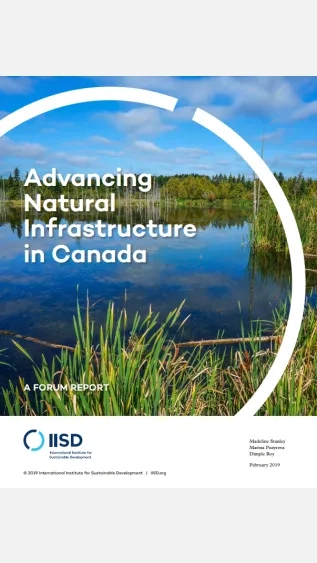
This report presents the key insights and recommendations from the Advancing Natural Infrastructure in Canada forum, convened by the International Institute for Sustainable Development (IISD) and partners in November 2018. This forum brought together experts in related fields from across the country to discuss how Canada can use Natural Infrastructure (NI) to build more resilient cities, towns and landscapes in the face of increasing climate uncertainty.
A New World: The Geopolitics of the Energy Transformation, analyzes the geopolitical implications of the global energy transformation driven by renewables. It is the culmination of ten months’ deliberations and consultations and informed by a number of background papers drafted by experts in the fields of energy, security, and geopolitics.
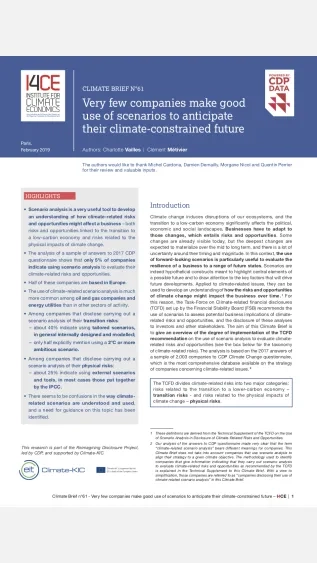
Climate change induces disruptions of our ecosystems, and the transition to a low-carbon economy significantly affects the political, economic and social landscapes. This Climate Brief gives an overview of the degree of implementation of climate-related scenario analysis to evaluate risks and opportunities by 2,003 companies surveyed in 2017.