

Northeast Asia Carbon Markets and Trade Connections published by Asia Society Policy Institute (ASPI) in collaboration with ICTSD focuses on carbon pricing and the linking of carbon pricing systems as a potential catalyst for increased trade relationships, and explores how the benefits from linking can be heavily impacted by trade relationships and competitiveness concerns within the economies of China, Japan, and Korea.
The report introduces the different approaches to carbon pricing and linking currently being used by the three countries, explains the benefits and challenges of linking different carbon pricing systems, and proposes ways to deepen integration of carbon pricing and trade policies to promote regional carbon market linkage as well as increase trade between all three countries.
The Climate Investment Funds (CIF) Administrative Unit, in collaboration with the CIF’s multilateral development bank (MDB) partners, sought to undertake an analytical exercise to draw lessons from the experience of the CIF and international finance institutions in supporting investment in energy efficiency. The aim of this study, Lessons from the Experience in Scaling-Up Energy Efficiency: Synthesis report was to better understand the effective use of public finance – in particular, concessional climate finance provided through the CIF – in scaling up investment in energy efficiency, mainly in middle-income countries, focussing specifically on demand-side energy efficiency.
The Climate Investment Funds (CIF) Administrative Unit, in collaboration with the CIF’s multilateral development bank (MDB) partners, sought to undertake an analytical exercise to draw lessons from the experience of the CIF and international finance institutions in supporting investment in energy efficiency. The aim of this study, Lessons from the Experience in Scaling-Up Energy Efficiency: Case study report was to better understand the effective use of public finance – in particular, concessional climate finance provided through the CIF – in scaling up investment in energy efficiency, mainly in middle-income countries, focussing specifically on demand-side energy efficiency.
This guide, A Guide to Multilateral Development Banks, provides a systematic comparative analysis of MDBs, aiming to build the evidence and inform reflections on the MDB system.
Early engagement with the disclosure of climate risks and opportunities enables companies to get ahead of forthcoming regulations, particularly in Europe. It allows them to anticipate and respond to investor concerns, and play an active role in shaping the field and establishing the standards that will eventually become the norm. This EBRD-GCECA report, Advancing TCFD Guidance on Physical Climate Risks and Opportunities, aims to inform and support early adoption efforts of this kind, recognising that the field is evolving rapidly and that best practices will emerge over time.
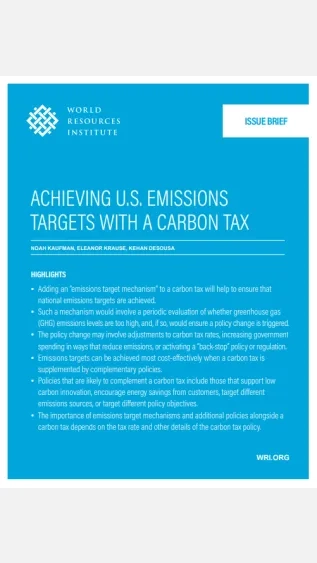
Achieving U.S. Emissions Targets with a Carbon Tax provides insight on how incorporating emissions target mechanism into a strong national carbon tax can help ensure intended emission cuts are achieved. This mechanism establishes predictable ways of adapting the carbon pricing program over time to respond to any shortfall in emissions reductions. The report describes a basic two-step process– periodic evaluation of whether emissions reductions are on track to meet targets followed by an adjustment mechanism if reductions are less than anticipated.
This report highlights following points: