
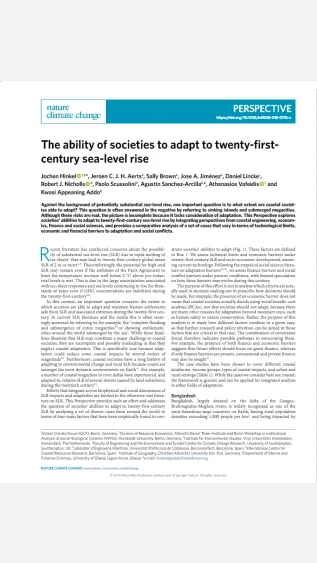
Against the background of potentially substantial sea-level rise, one important question is to what extent are coastal societies able to adapt? This question is often answered in the negative by referring to sinking islands and submerged megacities. Although these risks are real, the picture is incomplete because it lacks consideration of adaptation. In The Ability of Societies to Adapt to Twenty-First-Century Sea-Level Rise the authors integrate perspectives from coastal engineering, economics, finance and social sciences, and provide a comparative analysis of a set of cases that vary in terms of technological limits, economic and financial barriers to adaptation and social conflicts.
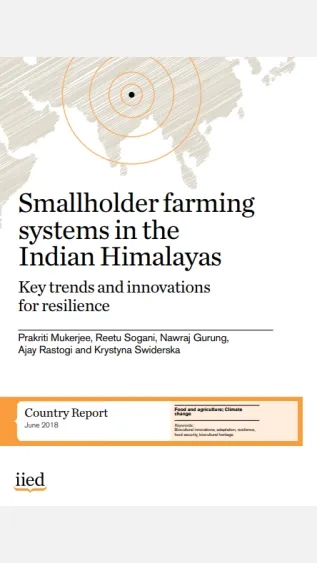
Traditional farmers in the Central and Eastern Indian Himalayas have observed significant climatic changes in recent years, reducing agricultural productivity. They have responded by innovating to increase resilience and yields, using traditional knowledge, biodiversity and external knowledge.
Smallholder Farming Systems in the Indian Himalayas: Key trends and innovations for resilience explores key trends in livelihoods, food security, crop diversity and biocultural heritage across ten communities; the biocultural innovations developed in response to climatic and socioeconomic changes; and the social factors that have supported biocultural innovation.

The Green Economy Barometer 2018: South Africa, produced by South African thinktanks the African Centre and Trade & Industrial Policy Strategies (TIPS) and supported by the Green Economy Coalition (GEC), provides a snapshot of the transition to a fair, green economy. It is drawn from evidence of policy progress as well as the insights of civil society organisations who are tracking the transition on the ground.
The study, Circular Economy in India: Rethinking growth for long-term prosperity, focuses on three areas key to the Indian economy and society: cities and construction, food and agriculture, and mobility and vehicle manufacturing.
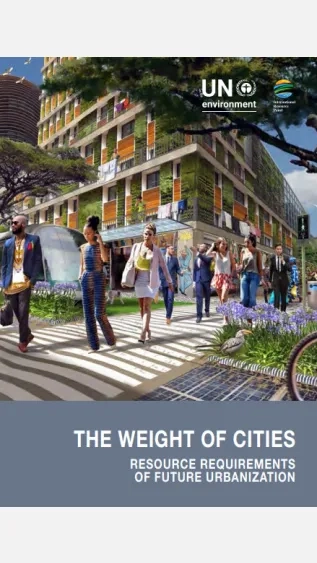
The Weight of Cities: Resource Requirements of Future Urbanization report calls for a new strategy for 21st Century urbanization, and presents the parallel actions on urban planning, sustainable design, resource-efficient components, and infrastructure for cross-sector efficiency that are required for a transition towards low-carbon, resource-efficient and socially just cities.
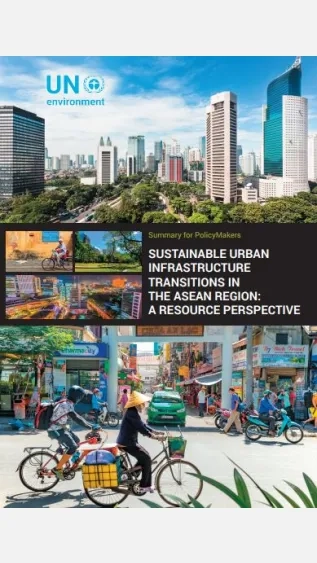
The Sustainable Urban Infrastructure Transitions in the ASEAN Region: A Resource Perspective report highlights five strategic infrastructure pathways for resource-efficient and inclusive urban development.