
This report titled Access to Environmental Information: A driver of accountable governance in Morocco and Tunisia? is a recent assessment in Morocco and Tunisia and reveals, governments and development partners can support access to environmental information and thereby accountable governance.
Finance Norway has developed a Roadmap for Green Competitiveness in the Financial Sector, pointing the way to a profitable and sustainable financial sector in Norway by 2030.
Measuring what matters in agriculture and food systems presents a synthesis of the results and recommendations of the TEEB for Agriculture and Food’s Scientific and Economic Foundations report, including an overview of the TEEBAgriFood Evaluation Framework.
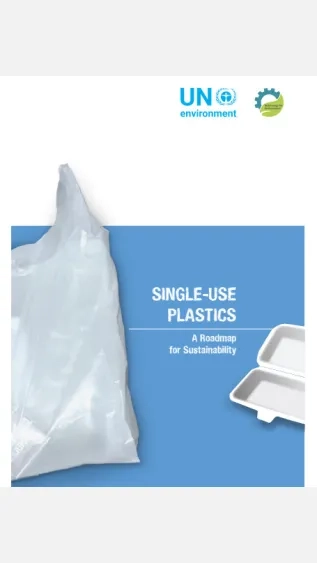
This report sets out the latest thinking on how we can more sustainably manage and curb single-use plastic pollution. It looks at what governments, businesses and individuals have achieved at national and sub-national levels to curb the consumption of single-use plastics. It offers lessons that may be useful for policymakers who are considering regulating the production and use of single-use plastics.
Renewable power accounted for 70% of net additions to global power generating capacity in 2017, but global energy-related carbon dioxide emissions rose 1.4% in 2017, after three years of holding steady. The increase in carbon emissions was the result of robust global economic growth (of 3.7%), lower fossil fuel prices and weaker energy efficiency efforts.
This year’s Renewables 2018 Global Status Report (GSR) reveals two realities: one in which a revolution in the power sector is driving rapid change towards a renewable energy future, and another in which the overall transition is not advancing with the speed needed. While momentum in the power sector is positive, it will not on its own deliver the emissions reductions demanded by the Paris climate agreement or the aspirations of Sustainable Development Goal 7. The heating, cooling and transport sectors, which together account for about 80% of global total final energy demand, are lagging behind.
A vast amount of investment is needed to tackle the infrastructural and technological requirements to bring about a transition to a low-carbon greener economy. While estimates vary, according to the OECD the total infrastructure investment required for a successful low-carbon transition from 2015 to 2030 is estimated at around $95 trillion, or around $7 trillion per year allocated to projects in the water and waste, telecom, energy and transport sectors. To ensure such a large investment total a vast mobilization of resources as well as private and public sector engagement, collaboration and funding will be necessary. The paper focuses on the case of ‘Use-of-Proceeds Green Bonds’ (UoP GB) that represent 95% of the market in 2016. It discusses the link between increasing investment in UoP-GB on the one hand, and the growth of investments in green projects by issuers, on the other hand, suggesting how this approach can be enhanced to achieve further impact. The paper shows that we currently lack evidence to conclude that as currently designed UoP GB contribute – or can without further enhancement contribute – to scaling up the investments in green projects.