
The Corporate Sourcing of Renewables: Market and industry trends report from the International Renewable Energy Agency (IRENA) highlights the latest trends and provides recommendations to more fully exploit such potential.
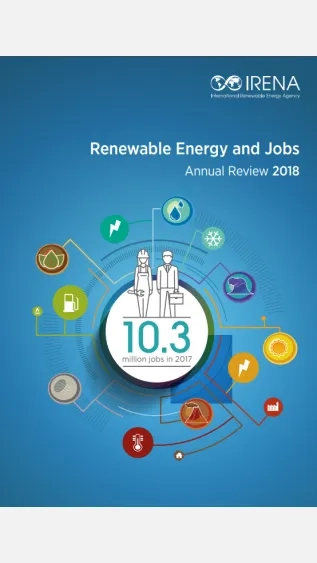
The industry created more than 500 000 new jobs globally in 2017, with the total number of people employed in renewables (including large hydropower) surpassing 10 million for the first time.
Renewable Energy and Jobs - Annual Review 2018, presents the status of employment, both by technology and in selected countries, over the past year. Jobs in the sector (including large hydropower) increased 5.3% in 2017, for a total of 10.3 million people employed worldwide, according to this fifth edition in the series.
China, Brazil, the United States, India, Germany and Japan have remained the world’s biggest renewable energy employers, representing more than 70% of such jobs. While growing numbers of countries reap socio-economic benefits from renewables, the bulk of manufacturing still takes place in relatively few countries. Four-fifths of all renewable energy jobs in 2017 were in Asia, the report finds.
Among the various technologies based on renewables, the solar photovoltaic (PV) industry supports the most jobs. PV jobs increased almost 9% to reach 3.4 million around the world in 2017, reflecting the year’s record 94 gigawatts of PV installation.
The concept of a circular economy and practice therefore merits close attention, as it can open new opportunities for trade and job creation, contribute to climate change mitigation and help reduce the costs of cleaning and scrapping in both developed and developing countries.
The working paper, Identifying Promising Policies and Practices for Promoting Gender Equity in Global Green Employment, is a synthesis of existing literature for promoting and optimizing women’s employment in manufacturing, construction and transportation.
The Creating and Optimizing Employment Opportunities for Women in the Clean Energy Sector in Canada report examines the role of women in energy production.
The paper titled Evaluating various choices of sector coverage in China’s national emissions trading system (ETS) is about sector coverage matters greatly in designing China’s national emissions trading system (ETS), with issues to be considered including impacts on emission reduction, economic and social welfare change, and carbon leakage to uncovered sectors.