
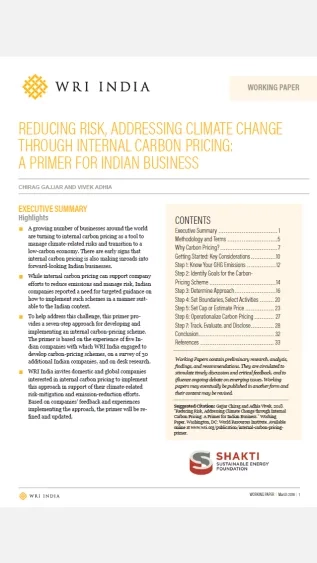
To help address this challenge, this primer Reducing Risk, Addressing Climate Change Through Internal Carbon Pricing: A Primer for Indian Business provides a seven-step approach for developing and implementing an internal carbon-pricing scheme.
This report Assessing Implementation of Environmental Provisions in Regional Trade Agreements assesses the progress of the implementation of environmental provisions in regional trade agreements (RTAs).
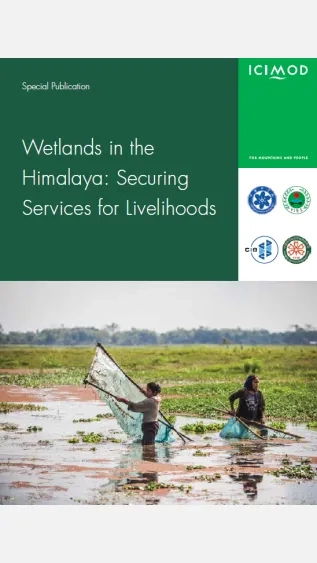
This publication provides a summary of the Regional Expert Symposium on ‘Managing Wetland Ecosystem in the Hindu Kush Himalaya: Securing Services for Livelihoods’, along with several scientific papers presented by experts on diverse topics like wetland ecology, status and threats, economic valuation, policies, benefit sharing mechanisms and traditional knowledge prevalent in the HKH region.
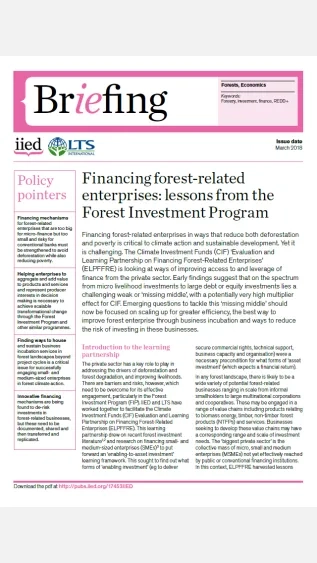
Financing forest-related enterprises in ways that reduce both deforestation and poverty is critical to climate action and sustainable development. The Climate Investment Funds (CIF) ‘Evaluation and Learning Partnership on Financing Forest-Related Enterprises’ (ELPFFRE) is looking at ways of improving access to and leverage of finance from the private sector. This International Institute for Environment and Development (IIED) briefing presents early findings from the evalutation. These findings suggest that on the spectrum from micro livelihood investments to large debt or equity investments lies a challenging weak or ‘missing middle’, with a potentially very high multiplier effect for CIF. Emerging questions to tackle this ‘missing middle’ should now be focused on scaling up for greater efficiency, the best way to improve forest enterprise through business incubation and ways to reduce the risk of investing in these businesses.
The report Korea Climate Bond Market Overview and Opportunities contains a host of recommendations to lever the potential in South Korea’s existing bond market - one of the largest in the world.
This brief Aligning fossil fuel production with the Paris Agreement focuses on how fossil fuel production fits into that process, using the three guiding questions of the Talanoa Dialogue: Where are we?Where do we want to go? and How do we get there?