
The role of technology transfer in the mitigation of climate change has been strongly emphasized in the recent policy debate. This paper Technology Diffusion and Climate Policy: A Network Approach and its Application to Wind Energy offers a network-based perspective on the issue.
This report Leveraging the Smart Grid: The Effect of Real-Time Information on Consumer Decisions reviews the literature on the impact of real-time information provision on consumer decision-making. In addition, it describes the results of a study in which about 7000 households in Ontario, Canada were provided with in-home displays linked to smart meters that provided real-time feedback on electricity consumption. The results show that electricity consumption declines by about 3% as a result of information feedback, that the reduction in demand is sustained for at least five months, and that it is highly correlated with outdoor temperature.
The Paris Agreement and the 2030 Agenda for Sustainable Development have generated a fast-growing interest in strengthening the links between climate change and other development priorities in Asia. Due to this growing interest, policymakers are increasingly looking for tools and methods that can analyse linkages between climate change and development priorities.
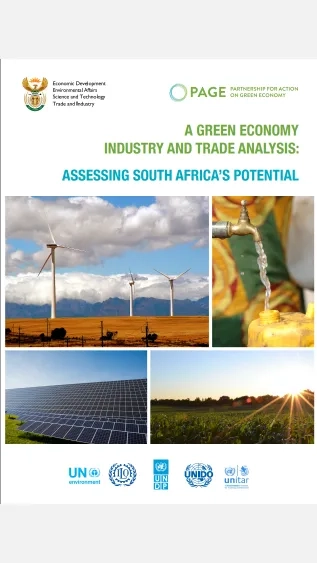
This analysis Green Economy Industry and Trade Analysis: Assessing South Africa's Potential focuses on the development of new trade opportunities for green industries in South Africa, both for import substitution and for exports.
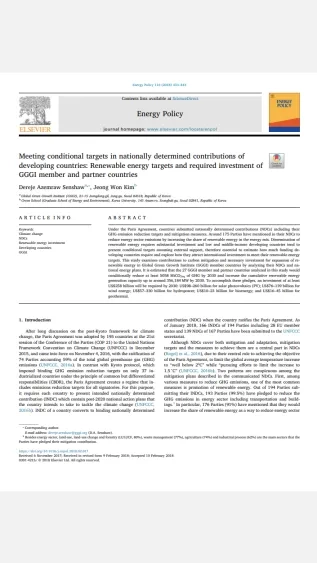
This study Meeting Conditional Targets in Nationally Determined Contributions of Developing Countries: Renewable Energy Targets and Required Investment of GGGI Member and Partner Countries examines contributions to carbon mitigation and necessary investment for expansion of renewable energy in Global Green Growth Institute (GGGI) member countries by analyzing their NDCs and national energy plans.
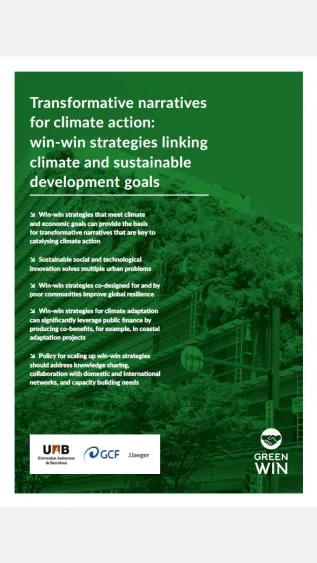
This policy brief, Transformative Narratives for Climate Action: Win-win strategies linking climate and sustainable development goals, discusses the key role of Transformative Narratives for catalysing climate action and elaborates some of the empirically-grounded transformative narratives produced in the GREEN-WIN project. In particular, the brief emphasises that win-win strategies that meet climate and economic goals can provide the basis for transformative narratives that are key to catalysing climate action. The brief discusses transformative narratives based on win-win strategies in the areas of rural energy poverty eradication, urban sustainability, and adaptation infrastructure. Additionally, the brief examines policies for scaling up win-win strategies like knowledge sharing, collaboration with domestic and international networks, and capacity building.