
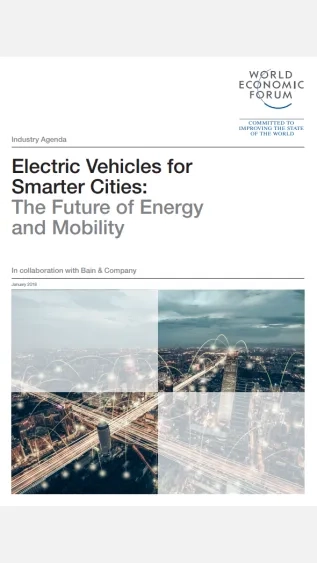
By 2050, about 70% of the world’s population will live, commute and work in urban areas. Between now and then, cities and suburbs will undergo significant transformations to create sustainable living conditions for their residents. Mobility and energy are the twin pillars of these transformations, and both will require radical adaptation to meet demographic and economic growth without increasing congestion and pollution. Cities will require mobility and energy solutions that are sustainable, affordable, secure and inclusive, and integrated with customer-centric infrastructure and services. Thus, the convergence of energy and mobility is critical.
These are exciting times in which new technologies allow people to rethink the way they live in a more sustainable and efficient manner. Smart mobility. Smart water. Smart grid. Smart integration. These are the foundations of tomorrow’s cities, which are being realized today.
The Inquiry's Annual Overview 2017 provides a summary of our work on aligning the financial system with sustainable development during 2017, divided in four themes: Country engagement; International collaboration; Cross-cutting themes: Green Invest and Green Digital Finance Alliance; Selected events
Making Blended Finance Work for the Sustainable Development Goals presents a comprehensive assessment of the state and priorities for blended finance as it is being used to support sustainable development in developing countries.
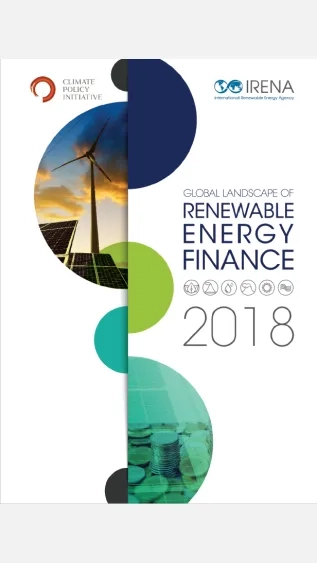
The landscape of renewable energy finance has evolved rapidly. Since 2012, renewable power capacity installations have exceeded non-renewables by a rising margin, representing about 60% of all new power-generating capacity added worldwide in 2016. Investment reached a comparable milestone in 2015, when renewable power technologies for the first time attracted more finance than non-renewable power technologies, a trend that has continued subsequently.
Global Landscape of Renewable Energy Finance analyses the renewable energy finance landscape. It outlines key trends globally in 2013-2016, regionally and by technology, examines the differing roles and approaches of private and public finance, highlights the important role of risk mitigation instruments, and provides an outlook for renewable energy finance in 2018 and beyond.
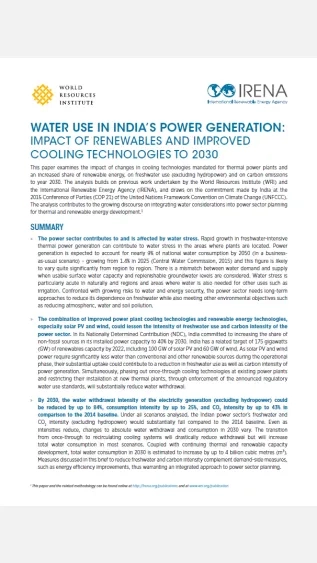
Water Use in India’s Power Generation: Impact of renewables and improved cooling technologies to 2030 analyses the prospective impact of renewable energy deployment, along with recently mandated changes to power plant cooling systems, on water use in India’s electricity sector. Looking at the expected freshwater intensity of non-hydro power generation under different scenarios, the analysis aims to quantify the impact of India’s energy transition on freshwater use. The findings highlight the need to incorporate water considerations into energy planning.
The World Resources Institute and the International Renewable Energy Agency (IRENA) conducted the analysis using data compiled from various sources on water withdrawal and consumption. The study considers the impact on water use in the context of IRENA’s REmap India analysis as well as power-sector scenarios from India’s Central Electricity Authority (CEA). The resulting brief focuses on India’s power generation at the national level.
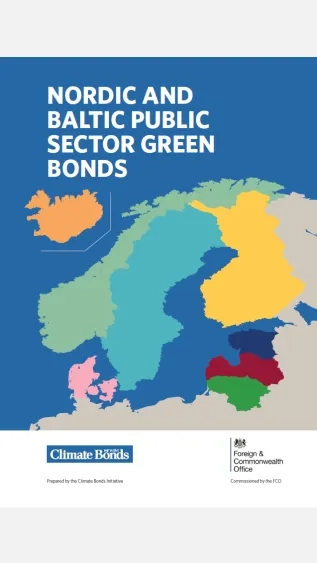
The report Nordic and Baltic Public Sector Green Bonds has a specific focus on the role of local governments, municipally owned companies (MOCs), state-owned enterprises (SOEs), and Local Government Funding Agencies (LGFAs) and along with Scandinavian nations includes Estonia, Latvia and Lithuania in its scope.