
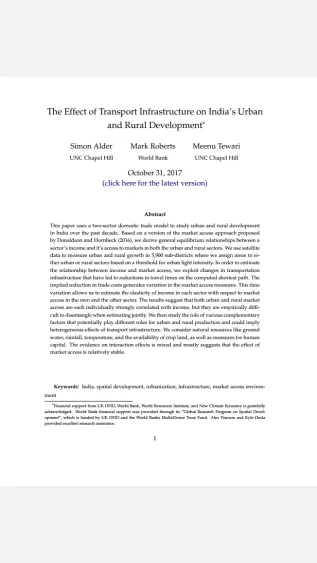
This paper uses a two-sector domestic trade model to study urban and rural development in India over the past decade. Based on a version of the market access approach proposed by Donaldson and Hornbeck (2016), the authors derive general equilibrium relationships between a sector’s income and it’s access to markets in both the urban and rural sectors. Satellite data are used to measure urban and rural growth in 5,900 sub-districts where areas are assigned to either urban or rural sectors based on a threshold for urban light intensity. In order to estimate the relationship between income and market access, the authors exploit changes in transportation infrastructure that have led to reductions in travel times on the computed shortest path. The implied reduction in trade costs generates variation in the market access measures. This time variation allows to estimate the elasticity of income in each sector with respect to market access in the own and the other sector. The results suggest that both urban and rural market access are each individually strongly correlated with income, but they are empirically difficult to disentangle when estimating jointly.
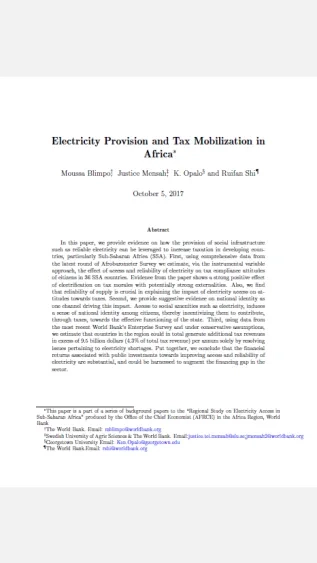
In this paper, the authors provide evidence on how the provision of social infrastructure such as reliable electricity can be leveraged to increase taxation in developing countries, particularly Sub-Saharan Africa (SSA). First, using comprehensive data from the latest round of Afrobarometer Survey the authors estimate, via the instrumental variable approach, the effect of access and reliability of electricity on tax compliance attitudes of citizens in 36 SSA countries. Evidence from the paper shows a strong positive effect of electrification on tax morales with potentially strong externalities. Also, it is found that reliability of supply is crucial in explaining the impact of electricity access on attitudes towards taxes. Second, suggestive evidence on national identity as one channel driving this impact is provided. Access to social amenities such as electricity, induces a sense of national identity among citizens, thereby incentivizing them to contribute, through taxes, towards the effective functioning of the state.
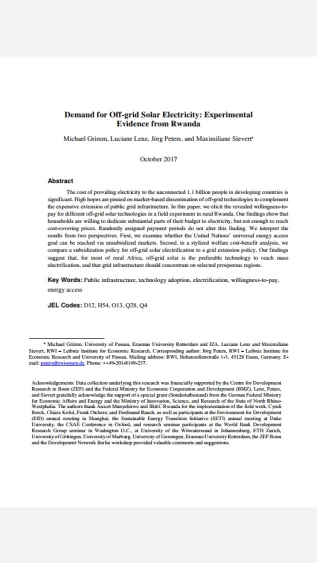
In this paper, Demand for Off-grid Solar Electricity: Experimental Evidence from Rwanda, reveals willingness to pay for different off-grid solar technologies in Rwanda.

The report Natural Heritage, Natural Wealth: Highlighting the Economic Benefits of the Belize Barrier Reef Reserve System World Heritage Site aims to capture some insight into Belize’s natural wealth through an economic assessment of the contribution of the Belize Barrier Reef Reserve System (BBRRS) to the economy.
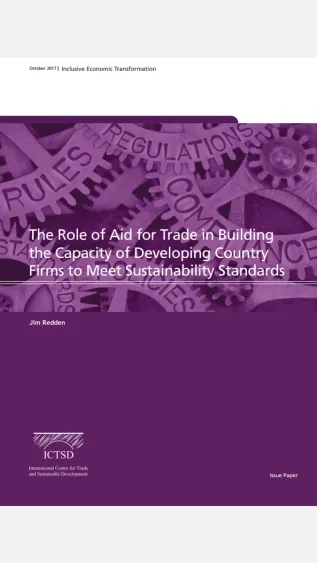
One of the major contemporary challenges facing developing country firms, and especially small and medium-sized enterprises (SMEs), is the ever increasing number of regulations and sustainability standards required of them if they are to integrate into global value chains. The paper "The Role of Aid for Trade in Building the Capacity of Developing Country Firms to Meet Sustainability Standards" focuses on the potential role that Aid for Trade—aid designed specifically to assist developing countries in overcoming supply-side issues and capture the gains of trade—can play in assisting those developing country SMEs and small producers who are struggling to comply with the sustainability standards required by value chains.
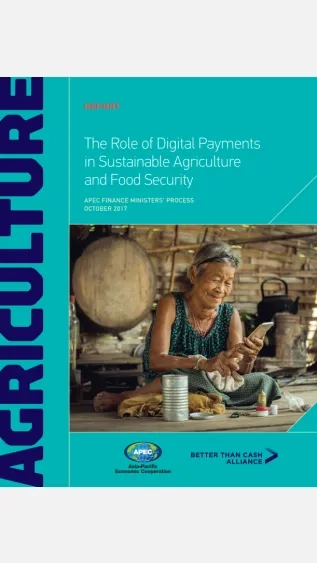
The paper The Role of Digital Payments in Sustainable Agriculture and Food Security examines how a shift to digital payments can provide powerful solutions that help countries improve agricultural productivity and ensure food security.