

Urbanization results in an increasing proportion of the population living in cities. Green spaces and other nature-based solutions offer innovative approaches to increase the quality of urban settings, enhance local resilience and promote sustainable lifestyles, improving both the health and the well-being of urban residents. Parks, playgrounds or vegetation in public and private places are a central component of these approaches.
The brief "Urban green spaces: a brief for action" aims to support urban policy-makers and practitioners by translating the key findings of a review of research evidence and practical case studies on urban green space interventions into implications for practice. It presents lessons learned and highlights aspects to consider when designing urban green spaces to maximize social and health benefits.
To access the related technical report "Urban Green Space Interventions and Health: A review of impacts and effectiveness", click here.
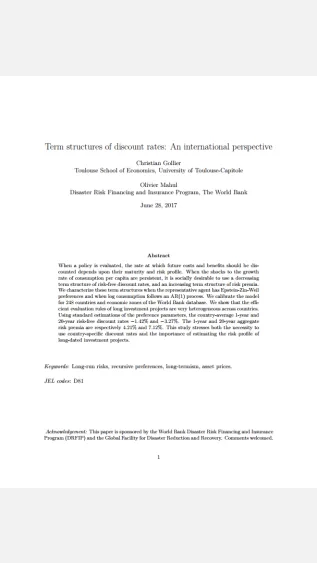
When a policy is evaluated, the rate at which future costs and benefits should be discounted depends upon their maturity and risk profile. When the shocks to the growth rate of consumption per capita are persistent, it is socially desirable to use a decreasing term structure of risk-free discount rates, and an increasing term structure of risk premia. These term structures are characterized when the representative agent has Epstein-Zin-Weil preferences and when log consumption follows an AR(1) process. The model is calibrated for 248 countries and economic zones of the World Bank database. The research shows that the efficient evaluation rules of long investment projects are very heterogeneous across countries. Using standard estimations of the preference parameters, the country-average 1-year and 20-year risk-free discount rates −1.42% and −3.27%. The 1-year and 20-year aggregate risk premia are respectively 4.21% and 7.12%. This study stresses both the necessity to use country-specific discount rates and the importance of estimating the risk profile of long-dated investment projects.
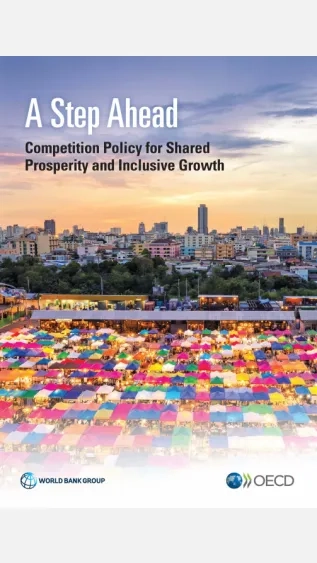
Governments from emerging and developing economies are increasingly requesting pragmatic solutions for effective competition policy implementation, as well as recommendations for pro-competitive sectoral policies. This book puts forward a research agenda that advocates the importance of market competition, effective market regulation, and competition policies for achieving inclusive growth and shared prosperity in emerging and developing economies.
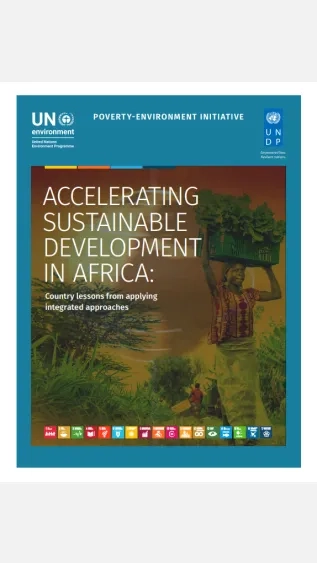
Livelihoods, poverty reduction efforts and economic growth in Africa are highly dependent on the quality and availability of natural resources, and are thus extremely vulnerable to degradation of those resources and to climate change. Development efforts hence need to equally embrace economic, social and environmental sustainability as emphasized in the recently adopted ‘2030 Agenda for Sustainable Development’ as well as ‘Agenda 2063 – The Africa We Want’. Several countries have made notable progress since 2005 through their partnership with the Poverty-Environment Initiative of UNDP and UN Environment.
The report Recommendations of the Task Force on Climate-related Financial Disclosures presents four widely adaptable recommendations on climate-related financial disclosures that are applicable to organisations across sectors and jurisdictions
The importance and value of 2050 strategies that seek to cut greenhouse gas emissions while also ensuring well-being and prosperity have been acknowledged by policy makers, advocates, and businesses for many years. However, there is no formal multi-lateral or international guidance as to what such strategies should contain or how they should be developed. While this is an important deficit that should be corrected, it is somewhat mitigated by a strong body of independent papers.
This paper aims to be a starting point for policy makers who are seeking to either develop their country’s first 2050 decarbonisation plan, or to strengthen their existing plan. The literature reviewed for these guidelines ranges from legislative texts and governmental agency reports to the outputs of independent research projects. While national circumstances will require some differences between countries’ 2050 strategies, the consistency with which the various papers identify the essential building blocks of a strong 2050 strategy should be noted.