
The Greening the Financial System: enhancing competitiveness through economic development briefing summarises the discussions held during a roundtable for market and policy leaders in Washington, D.C. on 20 April 2017.
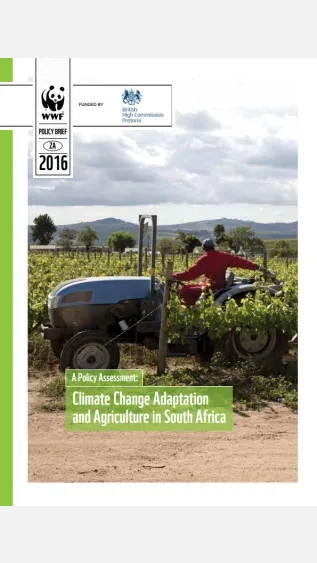
The policy brief Climate Change Adaptation and Agriculture in South Africa: A Policy Assessment considers the extent to which South African policies and strategic plans adequately address climate change adaptation in the agricultural sector.
It provides an overview of the interplay between climate change and agriculture in South Africa and unpacks an analytical framework underpinning the policy assessment. The brief reviews national policy documents and strategies based on this analytical framework and identifies key policy gaps based upon the review. It investigates the extent to which provincial (general overview of provincial coverage) and municipal (a limited sample of municipalities) governments address climate change adaptation in the agricultural sector and concludes with policy implications.
The Tracking Clean Energy Progress 2017 (TCEP) report highlights the overall status and recent progress in developing and deploying key clean-energy technologies.
Each year, TCEP assesses the latest progress in technology and market developments, tracks overall progress, and recommends further actions. TCEP this year shows that only 3 of 26 identified clean energy technologies are on track to meet a sustainable energy transition (one more than last year). 15 technologies showed only some progress, and 8 are significantly off-track and in need of renewed action.
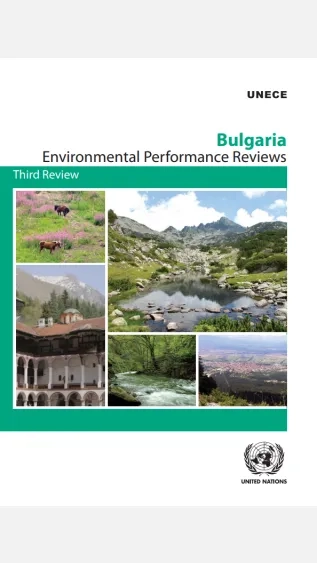
The Third Environmental Performance Review of Bulgaria takes stock of progress made by the country in the management of its environment since 2007.
This working paper undertakes econometric analysis to assess the impacts of climate mitigation policies and the quality of the investment environment on investment and innovation in renewable power in OECD and G20 countries. It also assesses how countries’ investment environments interact with climate mitigation policies to influence investment and patent activity in renewable power. The paper gathered and tested data across OECD and G20 countries on more than 70 explanatory variables, which were analysed using two Poisson-family regression models: one to investigate determinants of investment flows in renewable power from 2000 until 2014; and one to investigate determinants of patent counts in renewable-power technologies from 2000 until 2012.
Results of the econometric analysis are consistent with the main hypothesis in this paper that beyond setting climate mitigation policies, policy makers need to strengthen the general investment environment and align it with climate mitigation policies in order to mobilise investment and innovation in renewable power across OECD and G20 countries.
This report reviews 74 results-based climate financing (RBCF) programs implemented in developing countries with an objective to assess the characteristics and overall volume of funding flowing through RBCF programs, describe the various approaches to designing and implementing RBCF programs, and compare practical experiences with applying RBCF with the existing theory and literature.
The report finds that RBCF can: facilitate carbon pricing and market building, support host countries' policy processes to achieve their NDCs, and leverage private sector activity and financing. RBCF can thus play a critical role in mobilizing the resources and supporting the policies and actions needed to achieve the objectives of the Paris Agreement.