
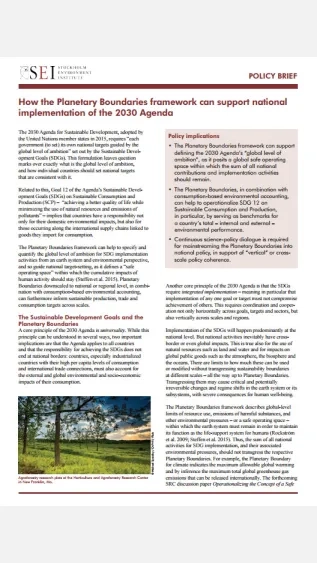
The 2030 Agenda for Sustainable Development, adopted by the United Nations member states in 2015, requires “each government (to set) its own national targets guided by the global level of ambition” set out by the Sustainable Development Goals (SDGs). This formulation leaves question marks over exactly what is the global level of ambition, and how individual countries should set national targets that are consistent with it. One way that the Planetary Boundaries framework can facilitate this process is by defining safe limits for human disturbance of a number of earth system processes – which are easily translated into global levels of ambition. These global ambitions and allocations can then be downscaled to the national level. Furthermore, the downscaled Planetary Boundaries, in combination with consumption-based environmental accounting, can help to operationalize SDG 12 on Sustainable Consumption and Production, in particular, by serving as benchmarks for a country’s total – internal and external – environmental performance.
The world’s biggest investors are responding to the global commitment to tackle climate change and are rapidly scaling up action to protect their portfolios, reveals this annual benchmark report on the industry from the Asset Owners Disclosure Project
The fifth AODP Global Climate 500 Index launches after a year of rapid developments in articulating the financial risks of climate change to the global economy. Climate risk rose further up the investor agenda in 2016. The Paris Climate Agreement came into force in November, including a recognition that financial flows must be aligned with the commitment to keep climate change well below 2C. Regulatory change is on the agenda, with France implementing a worldfirst mandatory climate risk disclosure requirement for institutional investors and the Task Force on Climate-related Financial Disclosures delivering its recommendations to the Financial Stability Board, for consideration by the G20 in July this year. The scales have tipped – a 60% majority of Asset Owners, and half of Asset Managers are now taking action to manage the risks and opportunities posed by climate change.
Climate change will affect all types of infrastructure, including energy, transport and water. Rising temperatures, increased flood risk and other potential hazards will threaten the reliable and efficient operation of these networks, with potentially large economic and social impacts. Decisions made now about the design, location and operation of infrastructure will determine how resilient they will be to a changing climate.
This paper provides a framework for action aimed at national policymakers in OECD countries to help them ensure new and existing infrastructure is resilient to climate change. It examines national governments’ action in OECD countries, and provides recent insights from professional and industry associations, development banks and other financial institutions on how to make infrastructure more resilient to climate change.
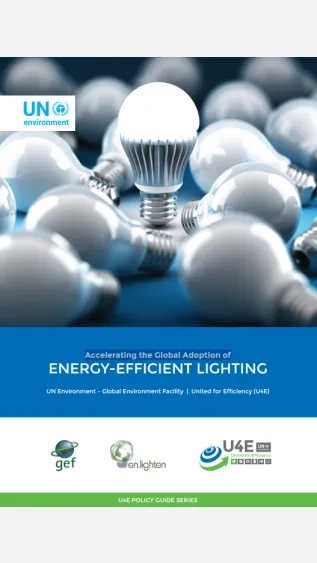
Lighting is widely used in everyday life. It is a significant factor contributing to our quality of life and productivity of our workforces. Artificial illumination extends the productive day, enabling people to work in homes, offices, buildings and factories. Lighting equipment, however, consumes resources. It does so in the manufacturing phase and, more importantly, when installed and operating (i.e. producing light). As our economies grow and populations expand, the global demand for lighting will increase. This period of technology transition from old to new products is an opportunity to governments. They can introduce cost-effective policy measures across all lighting applications yielding substantial savings and accelerating the adoption of LED-based lighting.
UN Environment and the World Bank Group view the overarching objective of a sound financial system as being to provide finance that meets the long-term needs of an inclusive, environmentally sustainable economy. While there is no single blueprint or unique pathway for creating such a “sustainable financial system”, it is possible to describe its many characteristics and progress towards it. Progress is being made in advancing a sustainable financial system. However, despite such positive momentum, we risk slipping backwards if financing for sustainable development remains inadequate, and if much financing continues to flow towards unsustainable production and consumption patterns.
The UN Environment and the World Bank Group’s Roadmap initiative intends to design an action plan that moves towards a sustainable financial system, including its elements, sequencing and principal actors, and a basis for measuring progress. The Roadmap will build on the extensive experience of both partners and many others active in the field. At this stage, aligning the financial system to SDGs and the Paris Agreement requires the Roadmap to include several core pillars.
The Earth’s climate is changing already and failure to limit warming to below 2°C could make the changes in the climate system irreversible and characterized by cataclysmic consequences. The adverse impacts of climate change continue to overly burden the poorest and the most vulnerable, especially poor women. Despite growing recognition of the differential vulnerabilities as well as the unique experiences and skills women and men bring to development and environmental sustainability efforts, women still have less economic, political and legal clout and are hence less able to cope with – and are more exposed to – the adverse effects of the changing climate. On the other hand, women are powerful agents of change and continue to make increasing and significant contributions to sustainable development, despite existing structural and sociocultural barriers. As the global community transitions to the implementation phase of the post-2015 development agenda, it is imperative that gender equality and women’s empowerment continue to influence, shape and drive the collective climate and human development effort.