
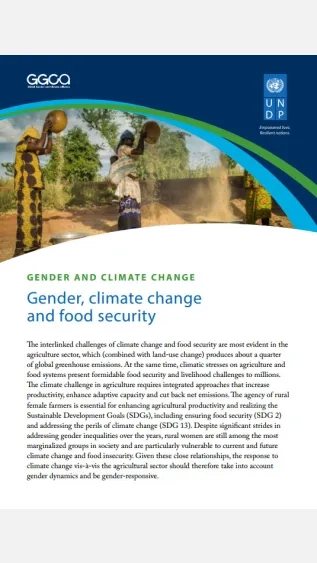
The interlinked challenges of climate change and food security are most evident in the agriculture sector, which (combined with land-use change) produces about a quarter of global greenhouse emissions. At the same time, climatic stresses on agriculture and food systems present formidable food security and livelihood challenges to millions. The climate challenge in agriculture requires integrated approaches that increase productivity, enhance adaptive capacity and cut back net emissions. The agency of rural female farmers is essential for enhancing agricultural productivity and realizing the Sustainable Development Goals (SDGs), including ensuring food security (SDG 2) and addressing the perils of climate change (SDG 13). Despite significant strides in addressing gender inequalities over the years, rural women are still among the most marginalized groups in society and are particularly vulnerable to current and future climate change and food insecurity. Given these close relationships, the response to climate change vis-à-vis the agricultural sector should therefore take into account gender dynamics and be gender-responsive.
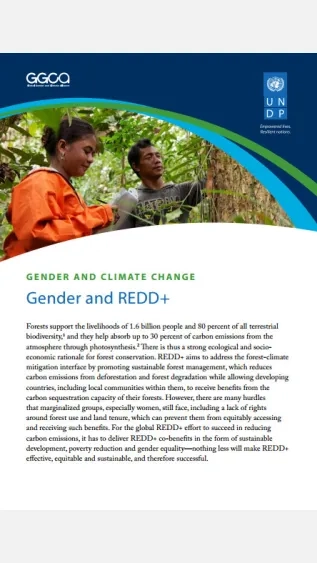
Forests support the livelihoods of 1.6 billion people and 80 percent of all terrestrial biodiversity, and they help absorb up to 30 percent of carbon emissions from the atmosphere through photosynthesis. There is thus a strong ecological and socioeconomic rationale for forest conservation. REDD+ aims to address the forest-climate mitigation interface by promoting sustainable forest management, which reduces carbon emissions from deforestation and forest degradation while allowing developing countries, including local communities within them, to receive benefits from the carbon sequestration capacity of their forests. However, there are many hurdles that marginalized groups, especially women, still face, including a lack of rights around forest use and land tenure, which can prevent them from equitably accessing and receiving such benefits. For the global REDD+ effort to succeed in reducing carbon emissions, it has to deliver REDD+ co-benefits in the form of sustainable development, poverty reduction and gender equality—nothing less will make REDD+ effective, equitable and sustainable, and therefore successful.
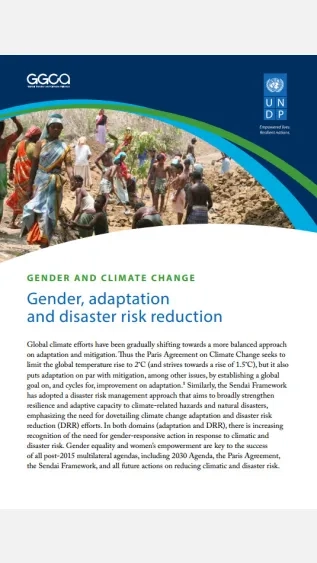
Global climate efforts have been gradually shifting towards a more balanced approach on adaptation and mitigation. Thus the Paris Agreement on Climate Change seeks to limit the global temperature rise to 2˚C (and strives towards a rise of 1.5˚C), but it also puts adaptation on par with mitigation, among other issues, by establishing a global goal on, and cycles for, improvement on adaptation. Similarly, the Sendai Framework has adopted a disaster risk management approach that aims to broadly strengthen resilience and adaptive capacity to climate-related hazards and natural disasters, emphasizing the need for dovetailing climate change adaptation and disaster risk reduction (DRR) efforts. In both domains (adaptation and DRR), there is increasing recognition of the need for gender-responsive action in response to climatic and disaster risk. Gender equality and women’s empowerment are key to the success of all post-2015 multilateral agendas, including 2030 Agenda, the Paris Agreement, the Sendai Framework, and all future actions on reducing climatic and disaster risk.
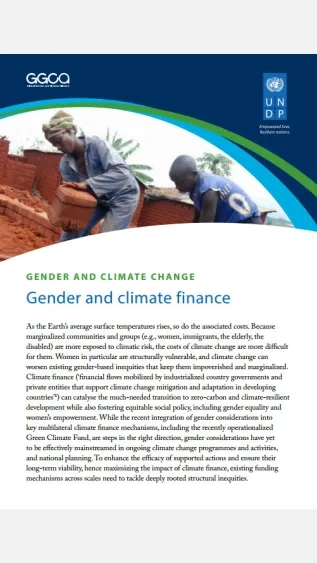
As the Earth’s average surface temperatures rise, so do the associated costs. Because marginalised communities and groups (e.g., women, immigrants, the elderly, the disabled) are more exposed to climatic risk, the costs of climate change are more difficult for them. Women, in particular, are structurally vulnerable, and climate change can worsen existing gender-based inequities that keep them impoverished and marginalised. Climate finance (‘financial flows mobilised by industrialised country governments and private entities that support climate change mitigation and adaptation in developing countries’) can catalyse the much-needed transition to zero-carbon and climate-resilient development while also fostering equitable social policy, including gender equality and women’s empowerment. While the recent integration of gender considerations into key multilateral climate finance mechanisms, including the recently operationalized Green Climate Fund, are steps in the right direction, gender considerations have yet to be effectively mainstreamed in ongoing climate change programmes and activities, and national planning.
The market for green bonds has risen from USD 3 billion in 2011 to USD 95 billion in issuance in 2016. For policy makers, the report proposes a framework for understanding potential directions of bond market evolution, increased convergence of rules and definitions, and quantitative analysis of the potential contribution that bond markets can make to a low-carbon transition.
This report describes the development of the green bond market as an innovative instrument for green finance and provides a review of policy actions and options to promote further market development and growth. The report provides an overview of global green bond market developments to date, barriers to growth, policy tools that can be applied to scale the market further, and quantitative scenarios for green bond market growth from 2015 to 2035.
The new Agenda for Sustainable Development, which aims to end poverty and promote well-being and prosperity while safeguarding ecological systems of the planet by 2030, has placed a much-needed emphasis on energy access and gender equality, elevating them as stand-alone sustainable development goals (SDGs). Similarly, there is now an increasing appreciation in international development discourses of the role of energy as a conduit for redressing historic gender inequities. Yet, energy poverty is still pervasive – one in five people in Africa and South Asia do not have access to electricity, and close to 3 billion people (40 percent of the global population) burn solid fuels such as wood, charcoal, animal waste or crop residues in open fires or inefficient stoves for their daily cooking and heating. As we transition into the 2030 development agenda, serious effort is needed to move beyond understanding the importance of both energy access and gender equality to viewing both as central to questions of sustainability, efficiency and effectiveness in the energy sector.