
The concept of a green economy has been advocated globally ever since it was first proposed. In China, green economy has been adopted as the national strategy for future economic development. In this paper, the authors applied statistical description, grey correlation, proportion and elastic coefficient analysis to assess contributions of green industry to the national development from 2008 to 2012. They find that: (1) The average green degree of China's economic industry, 45%, was relatively low. The relative green degrees from high to low were 65% for service industry, 55% for agriculture industry, and 24% for manufacturing industry, respectively. (2) The share that added values of green industry took up gross domestic product (GDP) was between 41% and 48%. Green industry growth was highly correlated to the national economic growth evidenced by their grey correlation coefficient of 0.8532. (3) Both categories and quantities of green products were increasing annually and the growth rate of exported green products exceeded 50% during the study period. The gross domestic product grew by 0.04% owing to the increase of 1% in green product exports.
This technical analysis for the Nordic Green to Scale report was commissioned to CICERO (Center for International Climate and Environmental Research – Oslo), which is Norway’s foremost institute for interdisciplinary climate research. The report illustrates the scaling potential of 15 proven Nordic low-carbon solutions and presents an analysis of the greenhouse gas emissions reductions of these solutions and their scalability internationally.
Green finance represents a positive shift in the global economy’s transition to sustainability through the financing of public and private green investments and public policies that support green initiatives. Two main tasks of green finance are to internalise environmental externalities and to reduce risk perceptions in order to encourage investments that provide environmental benefits.
The major actors driving the development of green finance include banks, institutional investors and international financial institutions as well as central banks and financial regulators. Some of these actors implement policy and regulatory measures for different asset classes to support the greening of the financial system, such as priority-lending requirements, below-market-rate finance via interest-rate subsidies or preferential central bank refinancing opportunities. Although estimations of the actual financing needs for green investments vary significantly between different sources, public budgets will fall far short of the required funding. For this reason, a large amount of private capital is needed.
Two simultaneous and interdependent issues challenge today’s development policy: poverty reduction and climate change. While economic growth is needed to tackle poverty reduction, governments need to set economic frameworks and incentive systems so that this growth remains within global environmental boundaries. When designed well, many of these measures can contribute to alleviating poverty and fostering competitiveness – that is, they can be used as green industrial policy measures.
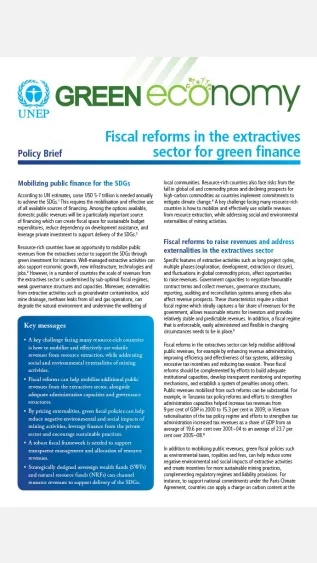
A key challenge facing many resource-rich countries is how to mobilize and effectively use volatile revenues from resource extraction, while addressing social and environmental externalities of mining activities. This UN Environment Policy Brief examines how fiscal reforms and other complementary measures in the extractives sector can help generate additional public revenues while reducing some of the negative environmental and social impacts from mining activities. It also explores how these resources can be channelled through a well-governed sovereign wealth fund (SWF) or natural resource fund (NRF) to support delivery of the SDGs.
This report aims to shed light on how EECCA countries and development co-operation partners are working together to finance climate actions, using the OECD DAC database to examine finance flows by provider, sector, financial instrument, channel, etc. A significant amount was committed by international public sources to the 11 countries comprising the EECCA in 2013 and 2014 (i.e. USD 3.3 billion per year), but the scale of such finance varies considerably from country to country and is insufficient to achieve and strengthen their climate targets communicated through the Intended Nationally Determined Contributions COP21.
In addition, while a range of climate-related policies have already been developed by the EECCA countries, the extent to which such policies are being effectively implemented and conducive to attracting climate finance is still unclear. In this respect, this report proposes a set of questions for the EECCA countries to self-assess their readiness to seize opportunities to access scaled-up climate finance from various sources: public, private, international and domestic.