
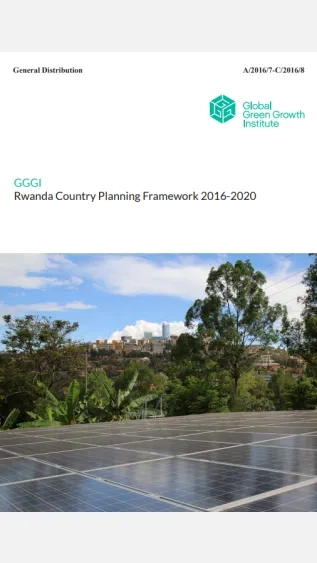
This Country Planning Framework (CPF) sets the strategic direction for the Global Green Growth Institute (GGGI) in Rwanda over the period 2016-2020.
This issue, The Circular Economy: Moving from theory to practice, is a special collection of articles about the transition taking place as companies use circular-economy concepts to capture more value from resources and to provide customers with better experiences.
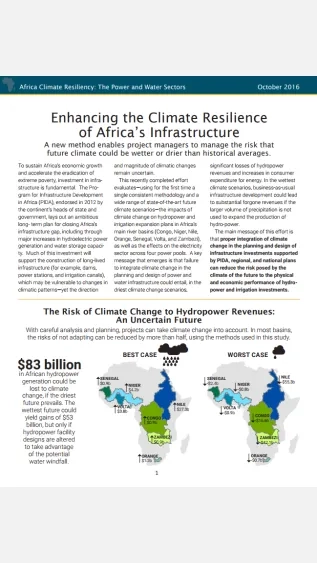
To sustain Africa’s economic growth and accelerate the eradication of extreme poverty, investment in infrastructure is fundamental. The Program for Infrastructure Development in Africa (PIDA), endorsed in 2012 by the continent’s heads of state and government, lays out an ambitious long- term plan for closing Africa’s infrastructure gap, including through major increases in hydroelectric power generation and water storage capacity. Much of this investment will support the construction of long-lived infrastructure (for example, dams, power stations, and irrigation canals), which may be vulnerable to changes in climatic patterns—yet the direction and magnitude of climatic changes remain uncertain. This recently completed effort evaluates—using for the first time a single consistent methodology and a wide range of state-of-the-art future climate scenarios—the impacts of climate change on hydropower and irrigation expansion plans in Africa’s main river basins (Congo, Niger, Nile, Orange, Senegal, Volta, and Zambezi), as well as the effects on the electricity sector across four power pools.
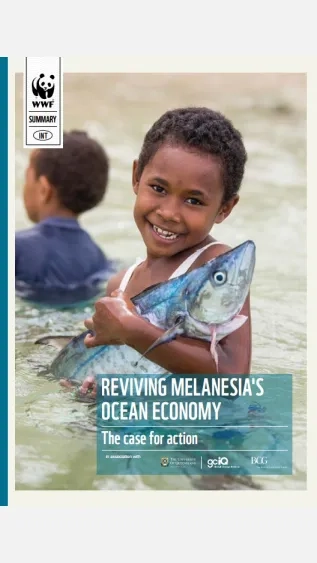
During the past few years, the term “Blue Economy” or “Blue Growth” has surged into common policy usage, all over the world. For some, Blue Economy means the use of the sea and its resources for sustainable economic development. For others, it simply refers to any economic activity in the maritime sector, whether sustainable or not.
Despite increasing high-level adoption of the Blue Economy as a concept and as a goal of policy making and investment, there is still no widely accepted definition of the term. To fill this gap in shared understanding about what characterises a sustainable Blue Economy, and to help ensure that the economic development of the ocean contributes to true prosperity, today and long into the future, WWF has developed a set of principles.
The United Nations 2030 Agenda for Sustainable Development, adopted in September 2015, includes Sustainable Development Goals with respect to climate change (SDG 13) and to ensuring access to sustainable energy (SDG 7). Questions of mitigation and adaptation to climate change are furthermore integrated throughout the Agenda. This think piece explores how trade rules, in particular, those established at the multilateral level, could support progress towards the 2030 Agenda’s objectives related to climate change and clean energy.
The authors focus on six key policy challenges at the intersection of trade policy and climate change and clean energy. They recommend prioritising policy actions in three areas: fossil fuel subsidies; clean energy subsidies; and access, dissemination, and transfer of climate-friendly technologies. The authors also suggest policy actions to tackle three other important issues: dealing with the political economy of local content requirements; pricing carbon nationally while tackling international competitiveness and carbon leakage concerns, and designing “carrots” and “sticks” for more ambitious action under climate clubs.
Carbon markets are expected to continue to play a key role in the mitigation effort under the Paris Climate Agreement. Cooperation in carbon market clubs can help reduce competitiveness and carbon leakage concerns, which has the potential to incentivise the uptake of more and increasingly ambitious carbon markets. This policy brief assesses the potential for carbon market clubs in light of the Paris Agreement and recently launched carbon market initiatives from a climate and trade policy perspective. It shows that additional efforts will be needed within and outside the UNFCCC for carbon market clubs to emerge and explores the challenges and opportunities the trade system may pose in this regard.