
Water is at the centre of economic and social development: it is vital to maintain health, generate energy and create jobs while sustaining the natural environment. A wide variety of economic, social and environmental services are derived from water resources, ranging from water supply and hydropower generation to navigation and recreation. Water resources are also an integral part of the natural environment, supporting biodiversity as well as underpinning the agriculture which provides the world’s food. This paper identifies some of the key intersections between trade policy and water management, in areas such as agriculture, hydropower generation, water services and wastewater management. While the local nature of water systems and the diversity of water management objectives is not conducive to the application of trade instruments to enforce a prescriptive, one-size-fits-all, approach to water management, the paper identifies a range of areas in which trade policy could support the sustainable management of water.
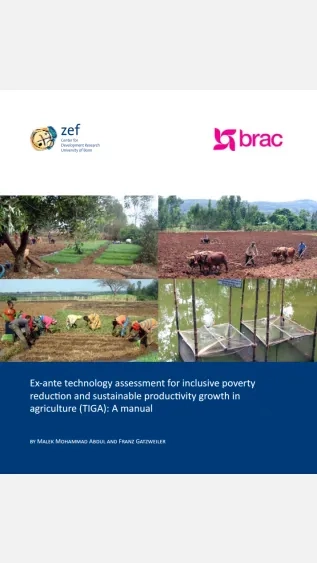
The manual presented here is based on the experience and draw out the collected lessons learnt with regard to the design and implementation of TIGA project in the South Asia and Sub-Saharan Africa. As such, this builds on and expands existing guidelines and documentation for agricultural technology assessment. It adds the perspective of technology assessment of including the cross section of segments of the rural poor characterized by varying degrees of overlapping human capabilities and agro-ecological potentials rather than the technology-driven approaches that tend to favor those with better adoption capabilities. The manual also gives the reader a well-documented experience of bottom-up approach for technology assessment.
The study presents an in-depth analysis of carbon markets in the USA and presents a model to offer comprehensive inquiry. The model takes inputs – including policy interventions and certain assumptions like population trends, GDP growth and energy prices – and generates outputs related to investment required, policy-induced avoided costs and added benefits in areas like employment and performance against secondary targets related to energy consumption and emissions. It also includes several variables across sectors and thematic domains.
In addition to summarizing these data in a user-friendly presentation, the study includes original research insights revealing tangible policy, investment and business trends. This study provides the most comprehensive overview to date for market actors to better "connect the dots" between INDCs and their impacts on investment portfolios, business operations, and national policy making.
The study is an in-depth analysis of carbon markets in China and presents a model to offer comprehensive inquiry. The model takes inputs – including policy interventions and certain assumptions like population trends, GDP growth and energy prices – and generates outputs related to investment required, policy-induced avoided costs and added benefits in areas like employment and performance against secondary targets related to energy consumption and emissions. It also includes several variables across sectors and thematic domains.
In addition to summarizing these data in a user-friendly presentation, the study includes original research insights revealing tangible policy, investment and business trends. This study provides the most comprehensive overview to date for market actors to better "connect the dots" between INDCs and their impacts on investment portfolios, business operations, and national policy making.
Over the past year, momentum towards a sustainable financial system has deepened, with a specific focus on green finance and climate risks. Clear pathways are bringing together three critical elements: market leadership by financial institutions; policy and regulatory innovation; and, over time, changes in governance, standard and norms. The precise blend and sequencing of these factors differs according to the issue at hand and country level financial cultures.
The result of these actions is the beginning of a new powerful dynamic between the financial system, real economy and progress toward sustainable development. Looking across the range of policy and regulatory measures under way that are driving this dynamic, five priority areas stand out: capital reallocation; risk management; the responsibilities of financial institutions; reporting and disclosure; and national roadmaps for sustainable finance (the '5R's). Added to this, the role of public financial institutions in both market creation and setting market norms is becoming clearer. The linkages between monetary policy and environmental outcomes are also increasingly a focus of attention.
Investing in sustainable infrastructure is key to tackling the three central challenges facing the global community: reigniting growth, delivering on the Sustainable Development Goals, and reducing climate risk in line with the Paris Agreement. This report identifies the main barriers to financing sustainable infrastructure and builds an action agenda to overcome them, including: tackle fundamental price distortions through fossil fuel subsidy reform and carbon pricing; strengthen policy frameworks and institutional capacities; transform the financial system to deliver the scale and quality of investment; and ramp up investments in clean technology R&D and deployment.