
This report, Financing Sustainable Development: Moving from Momentum to Transformation in a Time of Turmoil, proposes five steps to embed financing for sustainable development at the heart of tomorrow’s global financial system and deliver the much-needed transformation.
This report, Financing Sustainable Development: Moving from Momentum to Transformation in a Time of Turmoil, proposes five steps to embed financing for sustainable development at the heart of tomorrow’s global financial system and deliver the much-needed transformation.
The study Green Economy Fiscal Policy Analysis: Mauritius identifies areas with potential for improvement through the rationalization of current fiscal measures and the mobilization of further resources for innovation and investment.
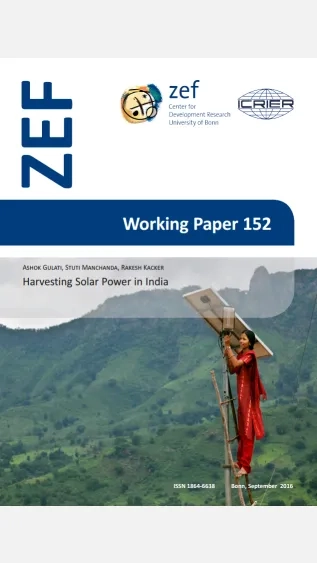
Prime Minister Narendra Modi has set an ambitious target of 100,000 MW of solar power capacity to be achieved by 2022, when India celebrates 75 years of her independence. This is a grand vision for ushering in a sort of revolution in clean energy in India in the next six years. In a country that generates more than 60 percent of its power by burning coal, and where air quality is fast worsening in several Indian cities, the need for clean energy cannot be overstated. Interestingly, Prime Minister Modi has also set another ambitious target of doubling farmers'
incomes by 2022!
The uppermost question in everyone's mind is: can these targets be achieved by 2022? This is particularly so when the current solar power capacity in the country has just touched 8000 MW by July end, 2016, and no country in the world has such an ambitious target as India has set out for 2022. On farmers' real incomes, the compound annual growth rate (CAGR) in the recent past (FY2003 to FY 2013) has been mere 3.5 percent; and doubling these incomes by 2022 would mean increasing this CAGR from 3.5 percent to more than 12 percent.
Innovation, Agricultural Productivity and Sustainability in Turkey is part of the OECD Food and Agricultural Reviews series. This review was prepared in close cooperation with Turkish Government. It examines the policy conditions for businesses in Turkey to undertake innovation for the food and agriculture sector to become more productive and environmentally sustainable.
This paper identifies opportunities to refine OECD’s indicators of land cover and land use and their regular production for all OECD and G20 countries. A comprehensive review is conducted of the available datasets at the global, regional and national levels, including data derived from remote sensing as well as those complemented with administrative and survey data. The datasets are assessed in terms of their geographic coverage, periodicity, spatial resolution, data reliability and comparability. The paper discusses the potential use of such datasets for the production of indicators that are harmonised across countries and over time. It is found that data on land cover are widely available and that many OECD countries have good-quality national land cover datasets, in some cases consistently over time. However, considerable differences have been found among the land cover products reviewed in terms of their geographic coverage, spatial, temporal and thematic resolution. For eight countries, no country- or region-specific data could be found (including Israel, Korea, Colombia, Costa Rica, India, Indonesia, the Russian Federation and Saudi Arabia).