
The adoption of the Paris Agreement at the end of 2015 and the EU’s intended nationally determined contribution (INDC) have confirmed the EU’s commitment to achieve decarbonisation by 2050. Transport accounts for about a quarter of EU greenhouse gas (GHG) emissions, representing the second-largest source of GHG emissions in Europe after the energy sector. The transport sector will play a significant role in the EU’s efforts to decarbonise its economy in line with its international commitments.
The purpose of this report is to examine different EU policy options to address transport emissions, with a special emphasis on passenger cars. It ‘thinks through’ the options that are currently assessed in the EU and considers how they could be put together in a comprehensive framework. The report concludes with a number of measures to lead EU transport decarbonisation policy. A distinction is made between i) no-regret options and ii) measures for consideration.
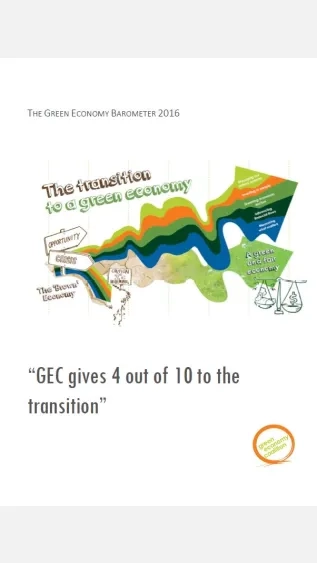
Since 2010 the GEC has been tracking the transition to green economies by drawing on the experiences and insights of GEC members and gathering different perspectives from different regions. The report aims to provide a brief but broad picture of what has been happening recently and where. It is focused on the five principles of change that define the GEC’s understanding of a green economy: 1. Economics for nature; 2. Green must be fair; 3. Transforming economic sectors; 4. Moving the money; 5. Measuring what matters.
Sustainable economic growth needs to be the primary objective of every government, including developing Asian countries, to improve the social welfare of the people. Therefore, to achieve the desirable level of sustainable economic growth, environmental degradation must be controlled without lowering real growth and the well-being of the society. This study empirically investigates the impact of environmental degradation by CO2 emissions on the economic growth of 11 Asian countries between 1990 and 2011. Based on the nature of the data, traditional panel estimation techniques encompassing fixed effects and random effects are employed, in which the results of Hausman's test and other tests show that the use of fixed effects is preferable over the random-effect estimator. Empirical results exhibit that environmental degradation has a significantly negative impact on economic growth. Empirical findings also suggest that environmental degradation should be regulated. Therefore, environmentally enlightened management policies for the decrease of CO2 emissions and fuel consumption by transportation and industries need to be pursued by Asian countries.
This report, Bridging Global Infrastructure Gaps, updates MGI's 2013 estimates of the world’s infrastructure needs and projected investment shortfalls. It also offers refined recommendations for bridging those gaps.
Demystifying Adaptation Finance for the Private Sector is a study by UNEP FI that analyse the role of private finance in confronting the challenges of climate change.
This paper, The Experience of Governance Innovations in South Africa, explores whether the extent to which Regulation 28, CRISA and JSE Integrated Reporting Standards have influenced the level of investment that integrates Environmental, Social and Governance (ESG) in its decision making process.