
In contributing to global climate change mitigation efforts as agreed in Paris in 2015, China has set a target of reducing the carbon dioxide intensity of gross domestic product by 60-65 percent in 2030 compared with 2005 levels. Using a dynamic computable general equilibrium model of China, this study analyzes the economic and greenhouse gas impacts of meeting those targets through carbon pricing. The study finds that the trajectory of carbon prices to achieve the target depends on several factors, including how the carbon price changes over time and how carbon revenue is recycled to the economy. The study finds that carbon pricing that starts at a lower rate and gradually rises until it achieves the intensity target would be more efficient than a carbon price that remains constant over time. Using carbon revenue to cut existing distortionary taxes reduces the impact on the growth of gross domestic product relative to lump-sum redistribution. Recycling carbon revenue through subsidies to renewables and other low-carbon energy sources also can meet the targets, but the impact on the growth of gross domestic product is larger than with the other policies considered.

The report Green Economy Scoping Study for Saint Lucia couples an in-depth analysis of Saint Lucia’s agriculture and tourism sectors with a more general review of manufacturing, transport and construction, integrating the key elements of energy, water and waste management.
The study recommends policy reforms that can help speed up the transition to a green economy in Saint Lucia which, like many Small Island Developing States, is disproportionately vulnerable to the impacts of climate change.It also dentifies the most significant challenges for the tourism sector: the high input costs (primarily for energy, water and waste management), competing uses for environmentally sensitive areas accompanied by inadequate land use policies (particularly in coastal areas) as well as the need to diversify Saint Lucian tourism beyond “sun, sea and sand” vacations.
The Little Green Data Book provides approximately 50 indicators for more than 200 countries based on World Development Indicators 2016 and its online database. Key indicators are organized under the headings of agriculture, forestry, biodiversity, energy, emission and pollution, and water and sanitation. Data is presented for the regions of East Asia and Pacific, Europe and Central Asia, Latin America and the Caribbean, Middle East and North Africa, South Asia, and Sub-Saharan Africa.
Several of these indicators have the potential to measure progress on the SDGs. These indicators measure the use of resources and the way human activities affect both the natural and the built environment including: measures of natural resources (forest, water, and cultivable land) and degradation (pollution, deforestation, loss of habitat, and loss of biodiversity).
The 2016 edition measures sustainability by expanding the conventional way of measuring national saving to include natural resource deplate and degradation of the environment as well as investment in human capital.
Armenia and Georgia are taking the climate change agenda seriously and contributing to efforts for mitigating global climate change through various ways, including preparation of low-carbon development strategies for their future economic growth. The improvement of energy efficiency is one of the key elements of the low-carbon development strategies. This study develops a methodology to estimate a marginal abatement cost curve for energy efficiency measures and applies it to the building sector in both countries. The study finds that among the various energy efficiency measures considered, the replacement of energy inefficient lightbulbs (incandescent lamps) with efficient lightbulbs is the most cost-effective measure in saving energy and reducing greenhouse gas emissions from the building sector. Most energy efficiency improvement options considered in the study would produce net economic benefits even if the value of reduced carbon is not taken into account.
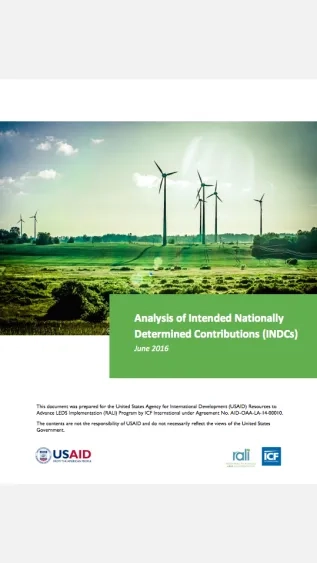
This white paper provides an analysis of the Intended Nationally Determined Contributions (INDCs) for 37 partner countries in the U.S. Government's Enhancing Capacity for Low Emission Development Strategies (EC-LEDS) program and other designated priority countries. The white paper includes an overview of global INDCs, country profiles for countries, regional trends, and sectoral trends. Moreover, each country profile includes information from the INDC on the:
The inclusive green economy has gained considerable attention in past years as an action-oriented approach and one of the tools for realizing sustainable development. The main contribution of this approach has been identified as integrating economic, social and environmental dimensions of development policies in a coherent, cross-sectoral framework of analysis. As governments begin to develop and implement inclusive green-economy strategies, more attention is being given to research into the use of methodologies and tools to identify social, economic and environmental trends, and the evaluation of the likely outcomes of implementing inclusive green economy policy.