
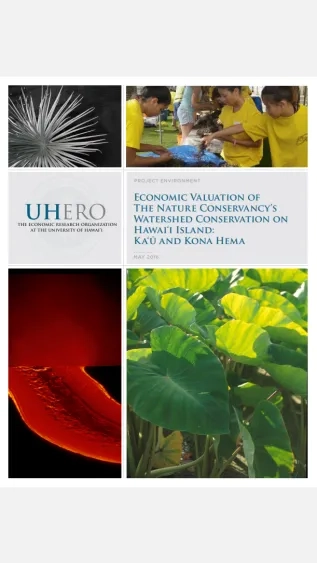
The objective of this research paper, Economic Valuation of The Nature Conservancy’s Watershed Conservation on Hawai‘i Island: Ka‘u and Kona Hema, was to estimate the value of ecosystem services protected by watershed conservation activities at The Nature Conservancy’s management units in the Kona Hema and Ka‘ū preserves on Hawai‘i Island. Projections of monetized benefts, together with trajectories of conservation costs, were then used to calculate net present value, payback period, and return on investment.
The report, Green Finance - A Growing Imperative, explored the implications of the greening of the financial system for financial market actors and policymakers.
Tomorrow’s financial system will not look like today’s. Possibilities will be shaped by new entrants and technologies and by shifts in the global economy’s centre of gravity. Crises and innovation may present unpredictable and alternative pathways of change.
The Inquiry, with support from the OECD, therefore developed a set of scenarios to frame discussions of the possible future policy contexts within which a sustainable financial system needs to evolve. Each of the four scenarios described in Designing for Disruption: The UNEP Inquiry Scenarios (Global Nudges, Emerging Accords, State Patchworks and Technology Edges) reflects a potential future in which the financial system is aligned with sustainable development, albeit in different ways.
The Paulson Institute, together with the China’s Green Finance Committee, the Securities Industry and Financial Markets Association (SIFMA), the United Nations Environment Programme (UNEP) and Bloomberg Philanthropies, co-hosted an event on 16 April 2016 at the Bank of America in Washington, D.C. to explore the implications of the greening of the financial system for financial market actors and policymakers.
This briefing note, Green Finance: A Growing Imperative conveys the key messages from the event, which are:
The working paper Industrial Waster Assessment in the Republic of Mauritius: Opportunities for Industrial Symbiosis aims to stimulate industrial symbiosis through the establishment of recycling activities and a circular economy.
Efficient buildings—those that make highly productive use of natural resources—are vital to achieving sustainable development: They align economic, social, and environmental opportunities, creating so-called “triple bottom line” benefits.
The Accelerating Building Efficiency: Eight Actions for Urban Leaders provides local governments and other urban leaders in cities around the world with the background, guidance, and tools to accelerate building efficiency action in their communities. The report focuses on eight categories of policies and actions that can help decision-makers plan for transformative change in their cities: Building Efficiency Codes and Standards; Efficiency Improvement Targets; Performance Information and Certifications; Incentives and Finance; Government Leadership by Example; Engaging Building Owners, Managers, and Occupants; Engaging Technical and Financial Service Providers, and Working With Utilities.