
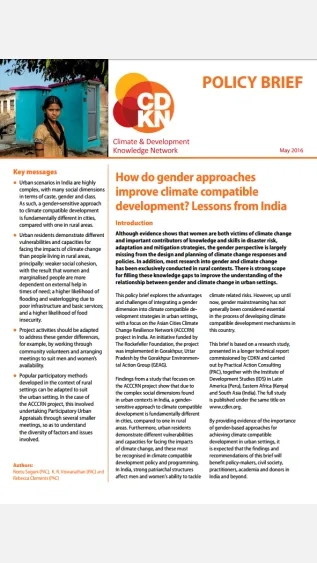
Although evidence shows that women are both victims of climate change and important contributors of knowledge and skills in disaster risk, adaptation and mitigation strategies, the gender perspective is largely missing from the design and planning of climate change responses and policies. In addition, most research into gender and climate change has been exclusively conducted in rural contexts. There is strong scope for filling these knowledge gaps to improve the understanding of the relationship between gender and climate change in urban settings.
This policy brief explores the advantages and challenges of integrating a gender dimension into climate compatible development strategies in urban settings, with a focus on the Asian Cities Climate Change Resilience Network (ACCCRN) project in India. An initiative funded by The Rockefeller Foundation, the project was implemented in Gorakhpur, Uttar Pradesh by the Gorakhpur Environmental Action Group (GEAG).
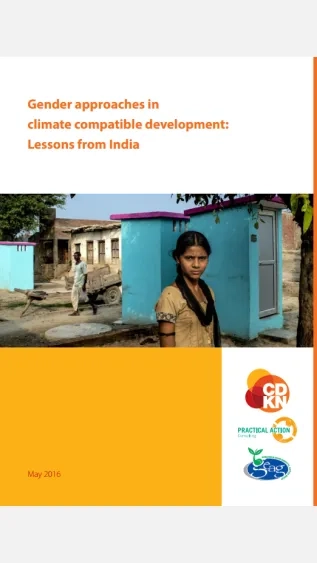
Climate change is increasingly recognised as a global crisis, but solutions have so far focused on scientific and economic options, rather than on the human and gender dimensions. Despite the fact that marginalised and poor people, including women, are affected first and hardest by climate change, evidence indicates that women’s views, needs and participation are excluded from the design and planning of climate change responses, including major policies. Moreover, women are often perceived primarily as victims, and not as equal contributors of knowledge and skills in disaster risk, adaptation and mitigation strategies.
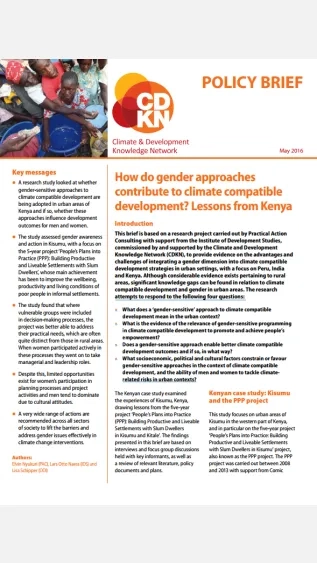
This brief is based on a research project carried out by Practical Action Consulting with support from the Institute of Development Studies, commissioned by and supported by the Climate and Development Knowledge Network (CDKN), to provide evidence on the advantages and challenges of integrating a gender dimension into climate compatible development strategies in urban settings, with a focus on Peru, India and Kenya. Although considerable evidence exists pertaining to rural areas, significant knowledge gaps can be found in relation to climate compatible development and gender in urban areas. The research attempts to respond to the following four questions:
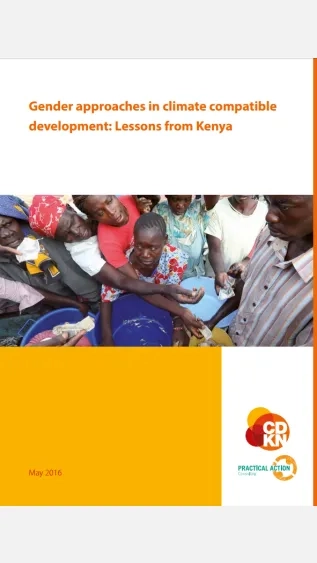
Gender is an important driver of vulnerability to climate risks, and a key factor to consider in developing effective policy responses to climate change and development challenges. In recent years, there have been a number of efforts to support gender equality as part of responses to climate change. However, gaps remain in drawing lessons from such efforts. This is especially true when it comes to understanding how gender relations affect people’s ability to adapt in urban settings. Given the impact that climate change and extreme weather events are having on urban populations around the world, there is a clear need to provide more evidence to inform climate change and development interventions.
This brief is based on a research project carried out by Practical Action Consulting with support from the Institute of Development Studies,commissioned by and supported by the Climate and Development Knowledge Network (CDKN), to provide evidence on the advantages and challenges of integrating a gender dimension into climate compatible development strategies in urban settings, with a focus on Peru, India and Kenya. Although considerable evidence exists pertaining to rural areas, significant knowledge gaps can be found in relation to climate compatible development and gender in urban areas. The research attempts to respond to the following four questions:
At the very end of December 2014, Indonesia introduced major reforms to its fossil fuel subsidies: removing subsidies to gasoline, except for distribution costs outside of the central islands of Java, Bali and Madura and introducing a “fixed” subsidy of IDR 1,000 per litre for diesel. At the same time, world oil prices plummeted. Together, these changes led to massive fiscal savings, equal to IDR 211 trillion (US$ 15.6 billion): over 10 per cent of state expenditure. This study investigates two central questions: Where were these savings reallocated? And is the new expenditure doing a better job for Indonesia’s development than subsidies? It concludes that fuel subsidy reform and reallocation in Indonesia have been a major step forward in improving public expenditure.