
To guide investors – both asset owners and investment managers – who are implementing ESG integration techniques in their investment decisions and processes, this report, A Practical Guide To ESG Integration For Equity Investing is the most comprehensive description to date of what ESG-integrated analysis is, and how it works in practice.
The Inaugural 2016 Report: Monitoring commitments and actions, is the first edition of the report of the Inter-agency Task Force on Financing for Development that maps out the commitments and action items contained in the Addis Ababa Action Agenda.
How Paris Became the Capital of Climate Finance traces the evolution of the ‘networked solution’ to finance that came together at the COP21 in Paris, linking the formal negotiations with a broader set of actions by financial regulators, by financial institutions and also by civil society. It explores the creative dynamic between France’s efforts to stimulate action within its own domestic financial system, and the international steps harnessing the financial system for climate security. It closes with reflections on how this new approach can be deepened in the year ahead.
Lenders and Investors Environmental Liability: How much is too much? presents an overview of Lender Environmental Liability (LEL) and Investor Environmental Liability (IEL) regimes and issues. Environmental harm and degradation are often irreparable. Therefore, our assumption is that precaution is the main objective of any international and domestic environmental legal regime. The paper explores the conditions under which LEL/IEL can be the effective tool to promote precaution. To illustrate our premise, we created a model based on Nash’s game theory in an attempt to universalize some basic concepts in the design of these systems. By using Nash’s game theory we aim to answer the question presented in the title of our paper: how much is a too much environmental liability for a financial institution to bear?
We argue that full environmental liability (where financial institutions bear unlimited liability) may have the perverse effect of incentivising them to internalize any duty of care, in case they bear full liability.
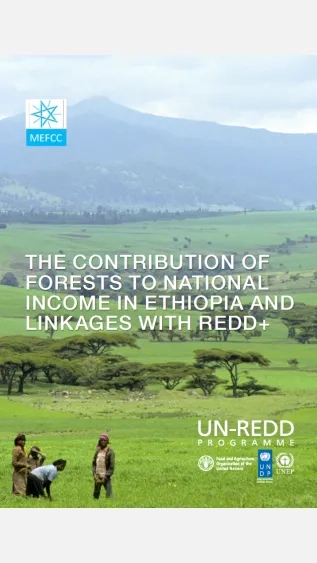
The Contribution of Forests to National Income in Ethiopia and Linkages with REDD+ presents the outcome of the assessment of the contribution of forest ecosystems to Ethiopia's national income (GDP). It shows that the contribution is considerably larger than previously thought.
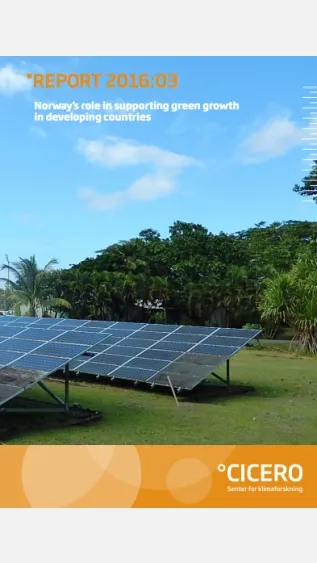
This report discusses green growth in developing countries, and Norway's role supporting such a green development strategy. After defining green growth in the context of developing countries, the report discusses indicators of green growth, barriers, and prominent instruments to facilitate green growth. Two case studies are presented, the first on green bonds in Ethiopia, and the second on introducing a green growth credit mechanism. The report concludes with some general findings, and findings linked to the two case studies.