
The present policy brief draws from an upcoming report by the Economic Commission for Africa (ECA), informed by a survey of nine selected projects in the Lake Victoria Basin complemented with literature, which has established that applying inclusive green economy-related principles and approaches enhances the outcomes of water resource management objectives. This policy brief provides a synthesis of the findings and recommends, among other things, the development and implementation of an inclusive green economy strategy or framework for water resource management in the Basin under the Lake Victoria Basin Commission.
The French version of the policy brief is available here.
This is the first in a series of six briefs, drawn from Achieving Sustainable Development in Africa through Inclusive Green Growth, a joint publication of the Economic Commission for Africa (UNECA), the Food and Agriculture Organization of the United Nations, the United Nations Industrial Development Organization and the United Nations Development Programme on the theme of "achieving sustainable development in Africa through inclusive green growth". This brief provides a snapshot of the key findings, which are further highlighted in subsequent policy briefs in this series.
This policy brief provides an overlook of green growth in a number of sectors, including agriculture, ecosystem goods and services, energy, industry, and trade. It also examines various enablers for the transition toward a green economy.
This policy brief is the last in a series of six briefs, drawn from Achieving Sustainable Development in Africa through Inclusive Green Growth, a joint publication of the Economic Commission for Africa (UNECA), the Food and Agriculture Organization of the United Nations, the United Nations Industrial Development Organization and the United Nations Development Programme on the theme of "achieving sustainable development in Africa through inclusive green growth". Specifically, this policy brief looks at the potential to leverage trade in achieving green growth as trade plays an important role in the world economy and can spur economic gorwth on teh African continent. It recognised that while extractives, particularly fossil fuels, raw ores and metals, dominate Africa’s exports to the rest of the world, African countries can achieve inclusive green growth within a highly globalized and competitiven world market by harnessing their abundant natural resources, which also provide a broad range of benefits across the various sectors of society.
This policy brief looks at the features of structural transformation and its desired outcomes in relation to an inclusive green economy, as well as the transmission mechanisms that could reinforce expected contributions and ensure the sustainability of the transformation. It takes a closer look at the macroeconomic policy landscape of the African continent and provides implementation experiences and summarises good practices on inclusive green economy policies.
The French version of the policy brief is available here.
This policy brief outlines the role and significance of various enablers that could facilitate a smooth transition to green economy in Africa, taking into account the implications for the region and highlights key messages that could inform the application of enabling measures in Africa for optimal policy impacts. It concludes that the transition to a green economy will not happen automatically; and creating certain ‘enabling’ conditions will provide incentives for various stakeholders, including public and private actors, to invest in, and contribute to building an inclusive green economy.
The French version of the policy brief can be found here.
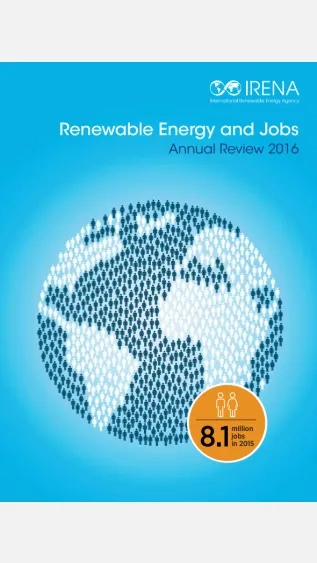
Renewable Energy and Jobs – Annual Review 2016 presents the status of renewable energy employment, both by technology and in selected countries, over the past year. In this third edition, IRENA estimates that renewable energy employed 8.1 million people around the world in 2015 (excluding large hydropower). This is a 5% increase from the number reported the previous year. In addition, IRENA conducted a second global estimate of large hydropower employment, showing approximately 1.3 million direct jobs in the sector.
While the growth in jobs slowed down compared to previous years, the total number of jobs in renewables worldwide continued to rise, in stark contrast with depressed labour markets in the broader energy sector. Countries with the highest number of renewable energy jobs were China, Brazil, the United States, India, Japan and Germany.