
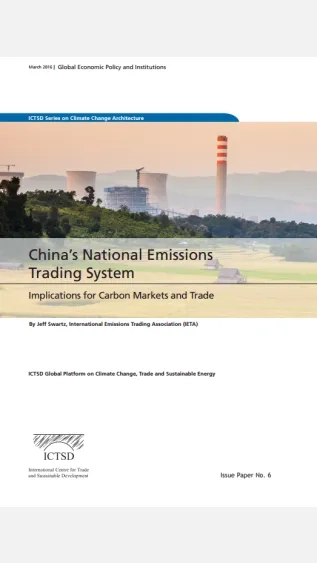
China’s introduction of a national ETS, scheduled for 2017, is an important development in the expanding carbon market landscape. As countries move towards implementation of the recently-adopted Paris Agreement, this sends a powerful signal about China’s mitigation commitment and support for carbon markets. As the largest emitter of greenhouse gases and a key player in world trade, China’s move to a nation-wide ETS can have significant implications for the future of carbon markets around the world.
In June 2014 the Government of India launched the Power for All initiative with an aim to provide 24x7 power across the country by 2019. Subsequently, a sub-committee of the Forum of Regulators (FoR) prepared a national roadmap for the initiative. FoR defined the scope of the initiative to include reliable 24x7 power supply to domestic, industrial, and commercial consumers, power supply to irrigation pump sets for 8 to 10 hours, and access to all connected households by 2018–19. The roadmap made recommendations for fuel supply, generation, transmission and distribution sectors, and demand-side management. In view of the federal structure of India’s power sector, a key recommendation of the FoR study was to formulate state-level strategies to meet the objectives of 24x7 Power for All.
As the world moves on from the climate agreement negotiated in Paris, attention is turning from the identification of emissions reduction trajectories—in the form of Nationally Determined Contributions (NDCs)—to crucial questions about how these emissions reductions are to be delivered and reported within the future international accounting framework. The experience to date shows that, if well designed, emissions trading systems (ETS) can be an effective, credible, and transparent tool for helping to achieve low-cost emissions reductions in ways that mobilize private sector actors, attract investment, and encourage international cooperation. However, to maximize effectiveness, any ETS needs to be designed in a way that is appropriate to its context. This Handbook is intended to help decision makers, policy practitioners, and stakeholders achieve this goal. It explains the rationale for an ETS, and sets out a 10-step process for designing an ETS – each step involves a series of decisions or actions that will shape major features of the policy.
Public-private partnerships (PPPs) are a relatively recent phenomenon in the irrigation sector; the El Guerdane project in Morocco is the first of its kind worldwide. Implemented in 2008, it now provides water to 10,000 ha of highly lucrative citrus fruit plantations. International development banks present this project as a success story, but results in terms of local development have been at best mixed. While some farmers have benefited from the initiative, others have experienced increased marginalization from water, fertile land, and development. Based on extensive field research in the El Guerdane area between 2005 and 2013, the present paper identifies three key critical issues posed by this PPP: partly negative effects on livelihoods and socioeconomic development; an unequal sharing of costs, benefits and risks between public and private partners; and uncertain environmental impact. Based on this analysis, the authors reflect on the significance of the project for the evolution of economic and political power relations in Morocco. This paper is only available in French.

In the field of adaptation governance research, current discussion on the barriers to adaptation shows that theoretical explanations for why institutions emerge and how they enable or constrain adaptation are underdeveloped. In this Perspective, the authors show that there is a significant opportunity to advance the understanding of adaptation governance by integrating insights that have been developed in the extensive commons literature on the institutions that work to overcome social conflicts or dilemmas. 'Realist-materialist' approaches to understanding such collective action are particularly valuable to adaptation governance research because they emphasize how biophysical conditions give rise to certain types of social dilemma. Climate change affects these biophysical conditions, and thus may alter dilemmas or create new ones. Based on realist-materialist reasoning, this Perspective describes six types of dilemma, illustrates each with a case from the adaptation literature and draws on insights from the commons literature regarding relevant contextual conditions and effective policy instruments for overcoming social dilemmas.
Buildings represent a key area for climate change mitigation. They account for approximately 30% of global energy consumption, and in turn generate around 20% of all energy-related greenhouse gas (GHG) emissions. Current trends in population growth and urbanization will lead to a significant need for new buildings in the near future. Such growth will bring with it a rise in energy consumption and associated GHG emissions – and not just from residential buildings but also the commercial and industrial developments that accompany them. Considerable opportunities exist to realize significant gains in energy efficiency and implement low-carbon strategies in urban areas.