
In 2013, the Nordic Ministers for the Environment decided to strenghten the measurement of green estimates of welfare and socio-economic developments. The report Making the Environment Count is describing how statistics on the environment and the economy thorugh the System of Environmental-Economic Accounts can be used to enable cross-sectorial analysis. The report proposes indicators that can be compiled annually in a Nordic context through existing statistics linking economic statistics to environmental statistics.
Energy efficiency policies play a key role in the transformation to a ‘green energy economy’. The paper takes stock of the impacts of the existing energy efficiency policy instruments in Germany and reviews the energy, environmental and socioeconomic impacts of the country’s latest energy efficiency and climate strategies for the year 2020. The authors find evidence supporting the findings of other studies that enhanced green energy policies will trigger tangible economic benefits in terms of GDP growth and new jobs even in the short term. Whereas policy makers have already acknowledged and implemented this conclusion in the case of renewable energies, the paper shows that striving for more ambitious energy efficiency policies represents a similar win–win strategy, which should be exploited to a much larger extent.
The paper examines the relationship between green innovation and employment from data taken from the Spanish Technological Innovation Panel (PITEC) for period 2007–2011. The increasing relevance of environmental issues for the Spanish economy, its unemployment problem and the uniqueness in its innovation structure make it a proper and interesting context to investigate green innovation dynamics. The authors find a positive relationship between green innovation and employment, and the relationship is stronger for firms in the so-called ‘dirty’ industries. In addition, they show that the relationship is positive for firms that introduce green innovation voluntarily, as compared to firms that introduce green innovation merely to comply with regulations. A positive and significant relationship is also found between employment and firms that report an increase in the degree of importance paid to green innovation.
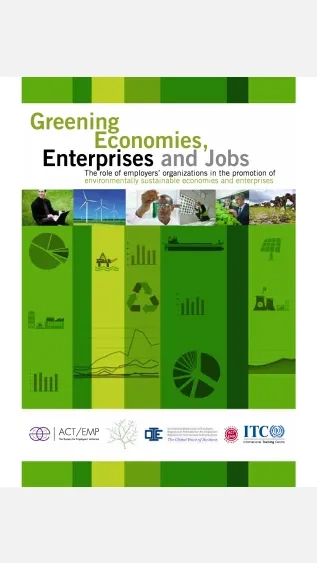
This resource guide provides an overview of the current sustainable development debate, the main environmental challenges and their implications for business, the greening of enterprises and workplaces, and the role that business and employers’ organizations can play in lobbying and service development in the environmental field.
It represents a major step forward in supporting and encouraging employers’ organizations and their members to take concrete actions towards more environmentally sustainable business development.
This publication is being launched at an opportune moment as the ILO has embarked on the “Green Initiative” as part of a reflection on the Future of Work in the lead up towards the ILO’s centenary in 2019. The Green Initiative aims at expanding the ILO’s knowledge base and strengthening its leadership in guiding constituents through the transition to more sustainable enterprises, economies and societies.
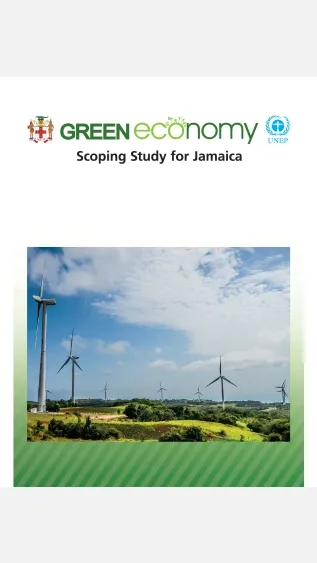
The Green Economy Scoping Study for Jamaica identifies and assesses key opportunities for greening country’s economy as a way to advance sustainable development. It describes the context and identifies opportunities at the macroeconomic level, as well as in five key sectors: energy, agriculture, construction, water and sewerage, and tourism. Based on a qualitative assessment of challenges and opportunities in the country, it proposes key policy and programme interventions that can advance a green economy.
Increasing international fragmentation of production has reinforced fears that industrial activity may flee to countries with laxer environmental policies – in line with the so-called Pollution Haven Hypothesis (PHH). If PHH effects are strong, domestic responses to environmental challenges may prove ineffective or meet strong resistance. Using a gravity model of bilateral trade in manufacturing industries for selected OECD and BRIICS countries over 1990s-2000s, this paper studies how exports are related to national environmental policies. Environmental policies are not found to be a major driver of international trade patterns, but have some significant effects on specialisation. More stringent domestic policies have no significant effect on overall trade in manufactured goods, but are linked to a comparative disadvantage in "dirty" industries, and a corresponding advantage in "cleaner" industries. The effects are stronger for the domestic component of exports than for gross exports, yet notably smaller than the effects of e.g. trade liberalisation.