
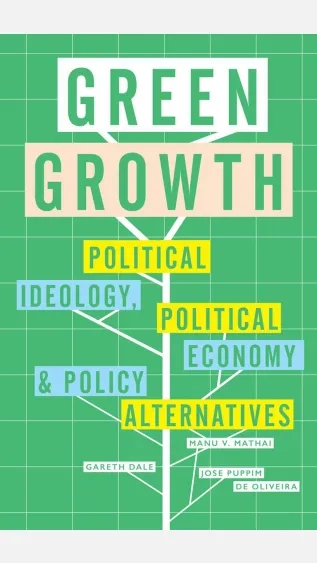
The discourse of “green growth” has recently gained ground in environmental governance deliberations and policy proposals. It is presented as a fresh and innovative agenda centered on the deployment of engineering sophistication, managerial acumen, and market mechanisms to redress the environmental and social derelictions of the existing development model. But the green growth project is deeply inadequate, whether assessed against criteria of social justice or the achievement of sustainable economic life upon a materially finite planet.
This volume outlines three main lines of critique. First, it traces the development of the green growth discourse qua ideology. It asks: what explains modern society’s investment in it, why has it emerged as a master concept in the contemporary conjuncture, and what social forces does it serve? Second, it unpicks and explains the contradictions within a series of prominent green growth projects. Finally, it weighs up the merits and demerits of alternative strategies and policies, asking the vital question: “If not green growth, then what?”
The 2015 EU Energy Union Package proposes integrating renewables into the market, just as the UK has moved away from Premium Feed-in Tariffs (FiTs) for renewable electricity supply (RES-E) to something closer to the standard FiT, which, when auctioned, demonstrated a 3% real fall in the weighted average cost of capital (WACC). The UK, which has experimented with nearly all forms of RES-E support, offers the evidence base for designing the Energy Union’s RES-E support. Innovation needs a further redesign to deliver adequate funding, best done through country contributions to an EU-wide innovation competition.

This paper investigates how the notion of ‘sustainability’ is strategically framed in the context of Dutch infrastructure governance in the Netherlands. By conducting a frame analysis (based on policy documents, websites and semi-structured interviews), the paper discerns six sustainability frames. These frames concern substantive (e.g., more focus on ecology), process (activating new networks) and organizational (e.g., new practices of work) aspects. The paper also illustrates how these sustainability frames relate to the changing institutional context of infrastructure policy and governance more broadly. The paper discusses some of the productive and challenging implications of the dynamics of sustainability in today’s complex and multi-dimensional world of governance.
Cities play a vital role in the global climate change mitigation agenda. City population density is one of the key factors that influence urban energy consumption and the subsequent GHG emissions. However, previous research on the relationship between population density and GHG emissions led to contradictory results due to urban/rural definition conundrum and the varying methodologies for estimating GHG emissions. This work addresses these ambiguities by employing the City Clustering Algorithm (CCA) and utilizing the gridded CO2 emissions data. Our results, derived from the analysis of all inhabited areas in the US, show a sub-linear relationship between population density and the total emissions (i.e. the sum of on-road and building emissions) on a per capita basis. Accordingly, we find that doubling the population density would entail a reduction in the total CO2 emissions in buildings and on-road sectors typically by at least 42%. Moreover, we find that population density exerts a higher influence on on-road emissions than buildings emissions.

This GGKP working paper explores four approaches to measure inclusive green growth (IGG): a dashboard of indicators, composite indicators, environmental footprints, and “adjusted” economic measures, it also identifies five main themes of relevance for measuring IGG.
Countries, including members of the G20, should strengthen the credibility of their pledges to limit or reduce annual emissions of greenhouse gases in order to build confidence in the Paris Agreement on climate change.
The report identifies the key determinants for policy credibility against which each country’s INDC pledges could be assessed. These are applied to the INDCs that were submitted by G20 members ahead of the Paris summit. No G20 country is found to have ‘no credible basis’ for their INDC across the determinants explored in this analysis. However, there are significant differences in the level of and balance among the determinants of credibility for the individual countries. Notably, three broad groups of countries can be identified: 1) Countries with most of the determinants at a level ‘largely supportive’ to credibility; 2) Countries with most of the determinants at least ‘moderately supportive’ to credibility, but displaying significant weakness in one of the determinants; 3) Countries that have scope to significantly increase their credibility across most determinants.