
The purpose of this paper, The Value of Everything, is to begin the process of clarifying global asset value especially as may be affected by the sustainability (or lack thereof) of financial systems, and not just that which is represented by institutional assets under management. This paper, therefore, will answer this question of what is the actual total value of all global asset classes individually and in aggregate, towards helping inform money flows as they relate to this overall global stock, and how do they or can they influence total value, as well as how should these stocks and flows shift to enable the financial system to become truly sustainable and how to measure for that.
Electronic markets and high-frequency trading (HFT) now comprise over half of all securities trading on both public “lit” exchanges and “unlit” dark pools and electronic platforms.
On 3 November 2014 Ethical Markets Media and the UNEP Inquiry convened an expert seminar in New York, bringing together securities market experts and traders to examine how the issues of electronic markets and high-frequency trading relate to the broader efficiency, effectiveness and resilience of financial markets in the face of environmental and social challenges, and to consider the potential of several market-based reforms.
This paper Public Finance and Climate Change Adaptation: Could Adaptation Policies Foster Public Fiscal Sustainability? The Case of Italy analyses the link between adaptation investment against flooding and how it affects the public budget and its sustainability in the medium run.
This research Analyzing the Coordinated Impacts of Climate Policies for Financing Adaptation and Development Actions investigates the effects on GDP and public budget of developed and developing countries of a coastal protection expenditure aimed to offset completely land lost to sea-level rise.
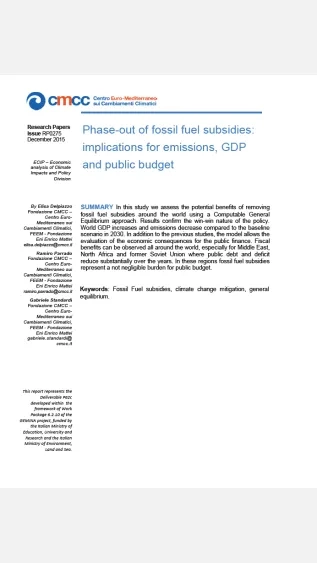
In this study Phase-out of Fossil Fuel Subsidies: Implications for Emissions, GDP and Public Budget assess the potential benefits of removing fossil fuel subsidies around the world using a Computable General Equilibrium approach.
The purpose of this paper A Study on Policy Directions for the Water-Food-Energy Nexus is twofold: (i) to identify the nexus interactions between water and energy system, and various nexus-based solutions that can address sectoral issues in both systems, (ii) to develop possible institutional arrangements, including public intervention, that can support the adoption of nexus approaches when they can enhance sustainability and resource security of each component systems.