

As various countries explore the merits of green growth in their policies and programs, the Republic of Korea’s (ROK) transition toward green growth serves as an exemplary model.
This report examines why and how the ROK has pursued green growth as a national priority and as a development paradigm, sharing major milestones achieved in various areas such as greenhouse gas emissions, green technology, resource efficiency, and energy security. Drawing on the expertise of sector specialists and practitioners, the report highlights the processes, outcomes, and key takeaways in advancing green growth planning and implementation in the Korean context to address fossil fuel dependency, economic slowdown, and climate change. It highlights how a confluence of milestones created a strong enabling environment for green growth in the ROK, laying out the institutional, legal, and programmatic platform for green growth.

This UNEP study seeks to provide governmental organizations engaged in Sustainable Public Procurement (SPP) with a step-by-step guide to planning, measuring and communicating the benefits they are creating through their SPP programs and activities.
In support of its ambitious target to reduce CO2 emissions the Scottish Government is aiming to have the equivalent of 100% of Scottish electricity consumption generated from renewable sources by 2020. This is, at least in part, motivated by an expectation of subsequent employment growth in low carbon and renewable energy technologies; however there is no official data source to track employment in these areas. This has led to a variety of definitions, methodologies and alternative estimates being produced.
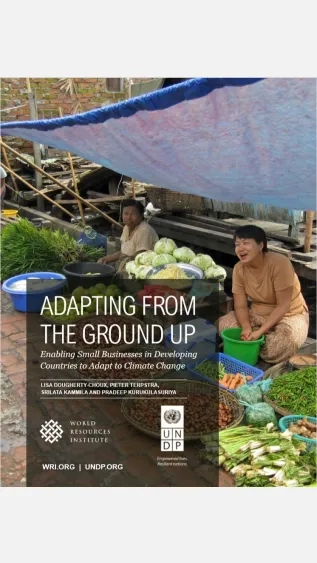
This report proposes a step-by-step framework for addressing the needs of small businesses in adapting to climate change. It discusses the factors driving micro and small enterprises (MSEs) to invest in adaptation, the breadth of barriers that they face, and interventions that policymakers can implement to address these barriers. It also includes detailed case studies on Zimbabwe, Cambodia, Tajikistan, and Nicaragua.
This report, Stock Exchanges and Sustainability forms part of the broader Inquiry and looks at not just effective mobilization of capital but the development of a financial system that is supportive of more sustainable outcomes. It does this by examining one part of the financial system, namely equity markets.
Stock exchanges have historically played an important role in economic growth and development through enabling effective capital allocation. However, exchanges and markets more broadly have changed over time, in structure, inter-connectedness and rate of activity. This has happened against a backdrop of growing recognition of the unsustainability of the current economic growth path in both social and environmental terms. Sustainability advocates and others have identified stock exchanges and evolving market structure as both contributors to the problem and a potential partner in the solution.
Scaling Up Green Bond Markets for Sustainable Development: A strategic guide for the public sector to stimulate private sector market development for green bonds argues that with the right support in place USD 1 trillion of green bonds could be issued a year by 2020 – providing a significant contribution to closing the investment gap for climate-friendly infrastructure in both developed economies and emerging markets. It argues for several sets of policy actions to support and enable the green bond market to grow:
- Market building activities are the low cost means to enable green bond markets to grow: Establish green project pipeline, strengthen local bond markets, strategic public green bond issuance and development of green bond standards.
- Proven support tools provide an additional boost to the market at its early stage: Strategic public green bond investment, credit enhancement, tax incentives and development of instruments to aggregate assets and structure risks.
- Innovative ideas are being trialled in some countries: Adjust risk weightings for green investments, preference green investments in central bank operations.